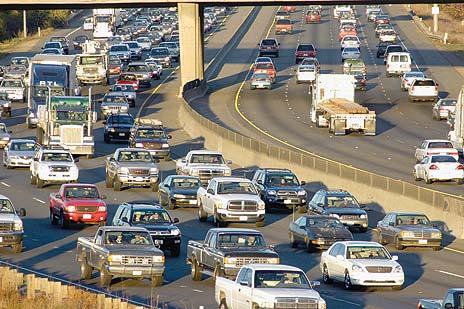
Measure B has been titled by the Sacramento Transportation Authority “The Road Maintenance & Traffic Relief Act of 2016.” What does traffic relief mean? It is being touted as meaning that there will be less congestion on our roadways. And who doesn’t want that? The problem is, it doesn’t work that way. Every time roads are expanded, more traffic shows up to use it. This is called induced demand.
Think about the history of Interstate 80. It has been expanded and expanded and expanded, yet it is still congested during commuting hours. How could that be? It is because with every expansion more people choose to commute, from Citrus Heights, from Roseville, from Auburn (and I’ve heard, from Colfax, now). New housing developments have gone in, homes bought by people that now see it as easy to drive into downtown where the vast majority of jobs in the region are. Caltrans is now spending $133 million on expanding Interstate 80 again (80 Across the Top). How long until it is again congested? Well, if the economy does well, probably two to three years. A five year construction project that will solve congestion for a short period of time.
There are four types of projects in Measure B that will induce demand: widening of Capital City Freeway, the Capital Southeast Connector, new interchanges, and road widenings and extensions.
Capital City Freeway (Business 80; technically State Route 51): Is this freeway congested? Yes, during commute hours, as anyone who uses it can tell you. SacTA proposes to add a bus/carpool lane and auxiliary/transition lanes to various sections, though not continously, from Interstate 80 to Highway 50/99. The sales tax measure allocates $200 million, but this is just match for a total project cost of $709 million (2013 dollars), expected to come from other sources. Meaning, your other taxes.
Capital Southeast Connector: This project would eventually construct a new, high volume freeway from El Dorado Hills to Elk Grove. The total project, which would run into the billions, is being done piecemeal, but the $126 million allocated in Measure B is a downpayment and match for the first phase. This project is a poster child for induced demand. Currently people who live in El Dorado Hills, Folsom, Rancho Cordova and Elk Grove must travel on congested roads if they want to live one place and work another. But new freeway will induce people who work in one of those places to live in another. And why not? The county just built a new road just for you to get to work. The problem is, as many people make just that decision, the road will become congested. And then the county will be back asking you for more money to expand the road. This project has the double devil aspect of inducing greenfield development, building new housing on what was productive agricultural land. In fact, the primary reason that so many in the construction industry are so strongly supporting the Southeast Connector is that it will make agricultural land with low property value a sudden bonanza for developers. (More about this when we get to a post about Greenhouse Gas Reduction).
Freeway interchanges: Measure B includes five completely new freeway interchanges, and one upgraded interchange. These interchanges allow significantly more vehicles onto the freeways, not reducing congestion, but increasing it.
Road widening and extensions: Measure B includes 16 road widenings and extensions. These projects induce traffic in the same way that freeway widenings and extensions do, by encouraging people to live further away from where they work, shop, socialize, and recreate.
Readers might be thinking, yes, but a lot of people these days don’t want to live a long way away from where they lead the rest of their lives. Exactly. Many people want to live, work, socialize and recreate close together, and to walk, bicycle and use transit to get where they want to go. Yet Measure B focuses on a 1970s model of suburban dispersion and long distance travel. This is 2016 and people are going a different direction. Why isn’t Measure B? It is true that there will always be people who want to live in suburbs and exurbs, and they can, it is a free country. But as I’m sure you noticed, it is more free for some people than others, and it does not make sense to make it free for long distance commuters with a tax subsidy from the rest of us.
Does induced demand work for other modes of transportation in addition to motor vehicles? It can. Build a wider and more welcoming sidewalk (or any sidewalk at all), and more people will walk. Build bike lanes and paths, and more people will bike. Build light rail extensions, and people will use it. So, induced demand is not necessarily bad, but the question is, what kind of demand are we inducing. Do we really want to induce long distance commuting? With light rail, the question is, will that extension be used more than another needed extension would be, or a bus route instead of light rail? Even light rail can induce long distance commuting, if it is built for that purpose. We will write more about that in future posts.
If you’d like to know more about the concept of induced demand, there are a large number of resources on the Internet (and some contrary voices), but some recommendations are Victoria Transport Policy Institute’s Generated Traffic and Induced Travel, Elements of Access from The End of Traffic and the Future of Transport, and Preservation Institute’s From Induced Demand to Reduced Demand.
 Sacramento Transit Advocates and Riders (STAR)
One thought on ““traffic relief” and induced demand”