
Measure B locks in a particular solution for airport transit service, missing less expensive and more efficient alternatives.
Measure B specifies $234,000,000 funding for a specific transit project, which is the Green Line to the Airport. The text is: “Light Rail Green Line extension (Township 9 – Natomas – Airport): 12.8 mile light rail extension from Township 9 at Richards Blvd over the American River into the Natomas Communities, continuing to a terminus at Sacramento International Airport. Project includes new track, overhead catenary, new stations, procurement of light rail vehicles, and a new vehicle maintenance facility.” This amount is meant to be a match for other funding obtained from the federal and state government. The match percentage is commonly 12%, though it varies with program from 0% to 33%, so the total could be $1,950,000,000 if the region successfully competes for funding. The Green Line to the Airport website studiously avoids mention of cost estimates, so I don’t know how much of the total project will be covered by about $2 billion, but I’m sure not all. Blue Line to CRC, now complete, was a $270,000,000 project, so this is likely a project on a far grander scale.
There is also a $180,000,000 allocation for operations and maintenance of the Green Line, Blue Line, and Gold Line, but it is not clear what the allocation would be to the three lines and between operations and maintenance.
Green Line to the Airport represents the biggest investment that has been made in transit in the region in quite a while, perhaps forever. It would be good to know that it is a well thought out project that was selected from among many as the highest possible value in terms of ridership and service area. Unfortunately, that is not the case. The project was NOT analyzed against other possible transit projects, and specifically not against projects to extend light rail south, northeast, and west.
The 2010 Green Line Locally Preferred Alternative (LPA) Issue Paper & Board Resolution, which is the most recent SacRT document with significant analysis of benefits and costs, uses a baseline of 15-minute headway bus service, operated from downtown to the airport. The operations cost of light rail to the airport would be double that of the bus, $17.8M rather than $8.2M. The capital costs would be about nine times higher, $756.4M rather than $85.1M (remember, these are 2010 dollars). The report does not provide ridership or cost effectiveness index numbers for the bus, because it is focused on obtaining federal New Starts funding, but it is worth noting that 1) ridership estimates assumed that the arena in Natomas would still be in operation, which it is not, and there are no definite plans for the site, and 2) the light rail all the way to the airport option had the worst cost effectiveness index of any of the extension options, barely meeting standards needed to actually receive New Starts funding. It is also worth noting that a number of things have changed since 2010, including the beginning of the revival of downtown, but what has not changed is the low density suburb vision for North Natomas, nor the low transit use nature of that community.
The Green Line to the Airport looks expensive, has fewer benefits than frequent bus service, and precludes for 30 years other worthwhile projects. What are the alternatives?
- Start frequent bus service to the airport, 15 minute intervals, in cooperation with Yolobus, which already provides service to the airport on an hourly basis. This could be done within one year. Compare this to the light rail schedule that would not even start construction until 2020, just for the next segment which might be to South Natomas, or might be to North Natomas, depending on funding. By some verbal estimates from SacRT, it would not reach the airport until 2035 at the earliest.
- Address the issue of traffic congestion along Interstate 5 between downtown and Interstate 80, which would impact the timing of buses going to and from the airport. Two options are to allow buses to travel on the shoulder, or to dedicate a bus only or perhaps high occupancy lane. Or some combination of those. These were addressed in a minor way in the locally preferred alternative analysis, but will need more study.
- Determine the appropriate kind of bus to operate on the route as a result of actual use and rider preferences. SacRT and Yolobus have sufficient buses to start pilot service, and a strong advantage to a pilot is that when new buses are purchased, they can match what is actually needed.
The Green Line to the Airport is not necessarily a bad project, and it is one that might eventually be built and be successful. However, Measure B, by precluding other transit options and other locations, reduces overall transit effectiveness in the region. There are many better ways to spend transit money in the near term, but Measure B does not allow that.
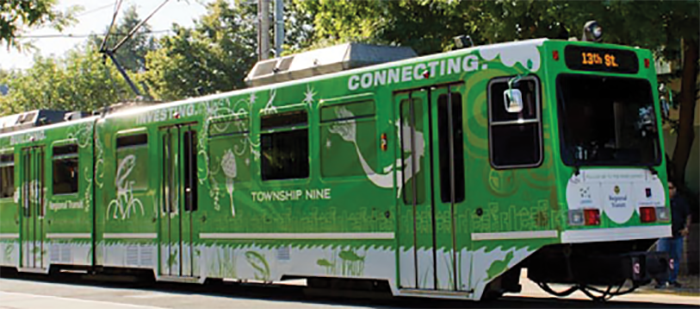
The Green Line to the Airport website uses as its header a photo of the current Green Line to Township Nine rail car, which is rather ironic since this light rail extension is a prime example of a light rail extension built too soon, based on an overly optimistic vision of ridership and development that has not come to fruition.
Getting Around Sacramento has posts on the Green Line that may be of interest.
 Sacramento Transit Advocates and Riders (STAR)
Strong Towns: Putting Our Towns on the Path Towards Good Public Transit makes a related argument for incremental changes in transit mode, from bus to bus rapid transit to light rail, as ridership increases and development occurs.
LikeLike