
STAR believes our transportation must provide safe options for all users, no matter what their mode of travel. We believe in Vision Zero. Sacramento County is currently far, far from providing safe travel. Measure B does not invest significantly in that goal.
Among the many benefits of Measure B being touted by proponents is traffic relief. We’ve already posted about how traffic relief, at least as envisioned by Measure B, does not work: “traffic relief” and induced demand. But even if it did work, is this really the right focus for transportation spending? It is not.
The focus should be on harm reduction. What harms? The high fatality and severe injury rates that have been created by our current transportation system, and the poor air quality that results from our transportation system. First, the crashes, and perhaps air quality in another post. The map below shows bicyclist and pedestrian crashes/collisions for the whole county, years 2009-2013. It is immediately obvious that these are not occurring in rural areas, or going to the airport, or along the Capital Southeast Connector route.
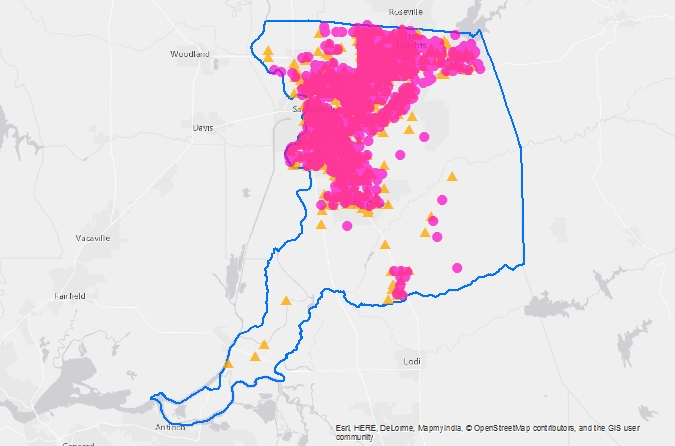
So where are they occurring? Along arterial roads in the urbanized areas of the county. Let’s zero in to a particular area, Rancho Cordova. I’m not picking on Rancho Cordova; its projects are about average, not as good as Citrus Heights but much better than Sacramento County.
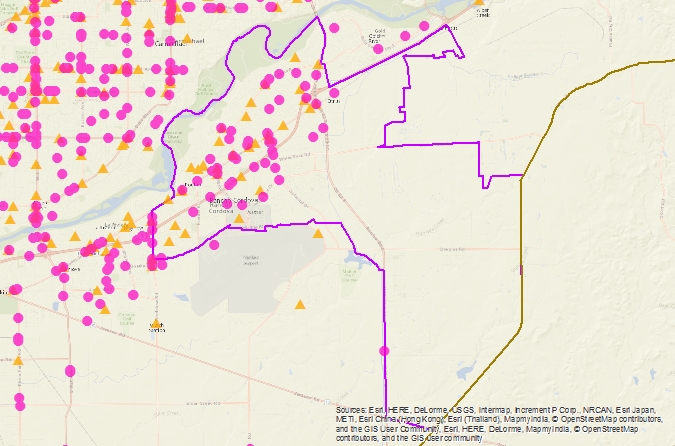
As you can see, most collisions occur on Folsom Blvd, Hwy 50, Bradshaw Rd (shared with the county), and Zinfandel Rd. Are these listed for Measure B? They are not. To its credit, Rancho Cordova has constructed sidewalks and bike lanes along parts of Folsom Blvd.
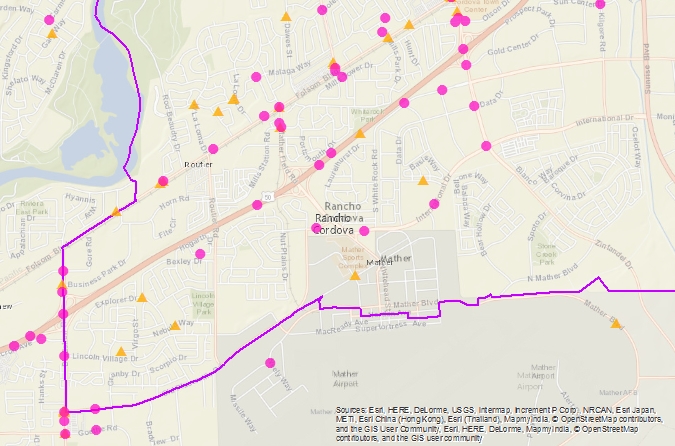
If we zoom in even more, you can see the roadways which ought to be of concern.
How about the Rancho Cordova/Hwy 50 Communities projects? Here is the list from the glossy fold-out mailer from measureb-yes:
- Hwy 50 interchange at Rancho Cordova Pkwy: NO safety benefit
- Reconstruct and widen White Rock Rd (the road that horizontally across the bottom of the city): NO safety benefit
- Widen Douglas Rd from Sunrise Blvd to west of city limits, including an additional bridge over the Folsom South Canal: NO safety benefit
- Double track Light Rail Gold Line to allow express service: very low safety benefit, as some people will shift from driving to light rail, which is safer
- Improve Hwy 50 interchange at Hazel Ave and extend Hazel Ave south: NO safety benefit
- Improve Jackson Hwy, Watt Ave to Sunrise Blvd: almost no safety benefit because there are almost no collisions
There are three other projects that are listed in the Transportation Enhancement Plan portion of Measure B:
- Sunrise Blvd Complete Streets Improvements (Folsom Blvd – Douglas Rd)
- Bicycle Master Plan Implementation
- Pedestrian Master Plan Implementation
These projects could potentially have a positive safety impact. But it is strange that these were not considered important enough to include in the list on the big glossy flier. Maybe not much is going to be done. Maybe little money is going to be devoted to these projects. We have to take the pro-B people at their word, though, that they did put in what was important to them. Safety does not seem to be.
Again, we are not picking on Rancho Cordova, but using them as an example of the kinds of “traffic relief” projects that get the majority of road funding in Measure B. Is this how we want to spend out money? Would not reducing fatalities and severe injuries be a much more useful investment?
 Sacramento Transit Advocates and Riders (STAR)