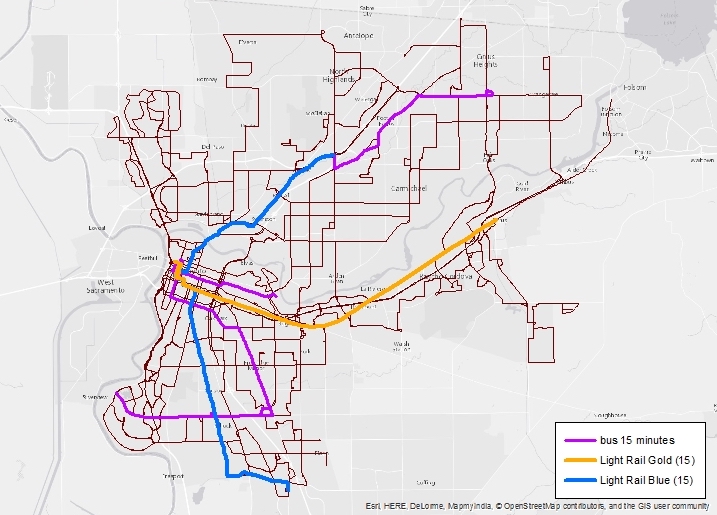
One of the key components of transit design is service frequency. The transit network in Sacramento County has a few frequent routes, but it has a large component of coverage, going to most locations with low frequency. A high ridership transit network would shift away from coverage and towards frequent service.
For an effective explanation of why frequency is so important, you can do no better than read Jarrett Walker’s post Explainer: The Transit Ridership Recipe on Human Transit.
“…frequency is the single most important variable in meeting our mobility desires.” – Jarrett Walker
What is frequent service?
- frequency: Almost every source agrees that it is every 15 minutes or better. In dense urban areas the service can be as frequent as 6 minutes, but in a moderately dense area like the urbanized areas of Sacramento County, 15 minutes is a good target.
- duration: There is less agreement about the duration or span of service. Some sources say a minimum of 15 hours per day, some accept as few as 11 hours per day, with less frequent service before and after those hours. Some systems in dense urban areas may be 24 hours a day. For SacRT, the frequent service route service hours are 5:00AM to 11:00PM (18 hours) on light rail and 5:30AM to 10:00PM (16.5 hours) on bus routes. Most other routes have significantly shorter duration.
- days: Some sources say service should be every day, others accept lower frequencies on weekends. SacRT has a number of routes that do not run on weekends at all, and many that offer infrequent service on weekends. There is no frequent service (15 minutes) on any SacRT route on weekends.
SB 375 and SB 743 define “high-quality transit”: “For purposes of this section, a high-quality transit corridor means a corridor with fixed route bus service with service intervals no longer than 15 minutes during peak commute hours.” Transit priority projects must be within a half mile of a high quality corridor to be eligible for GGRF (Greenhouse Gas Reduction Fund) money and for exemption from some CEQA requirements. Though this language does not require transit agencies to offer high-quality service, it is likely that the requirement will show up in more and more programs over time as the state works to meet GHG reduction goals.
A high frequency service that focuses on commute hours will serve that function well, but will not serve all the other functions of a transit network. The proportion of trips by private vehicle that are related to work is now down to about 15%, and though we don’t have information on whether transit is the same, it seems likely. In the successful redesign of the Houston transit network to focus on high frequency, service hours are long and seven days a week, and weekend ridership has increased at a much more rapid rate than weekday ridership.
The two maps below, from Getting Around Sacramento, show the entire SacRT network, and then the sparse frequent network. SacRT’s frequent network is 15 minutes, usually 5:30AM to 7:00PM, weekdays.
The issue of frequency is important to both how SacRT designs and operates its routes now, and what criteria should be used in a future tax measure when one is developed to replace the failed Measure B. So you will be hearing a lot more about it!


 Sacramento Transit Advocates and Riders (STAR)
One thought on “frequent service”