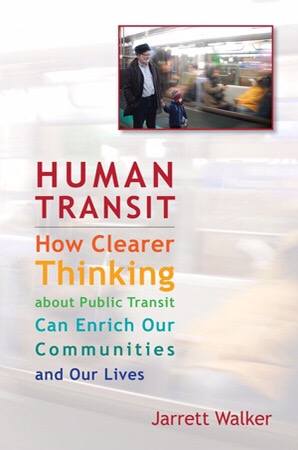
 The fourth and last resource useful in considering light rail in downtown is Human Transit by Jarrett Walker, both a book and a blog. A reading of the book three years ago absolutely transformed by thinking about and relationship to transit (Dan Allison). We have used some quotes from Walker: …beyond your walking range… and …frequency is the single most important….
Walker lists the seven demands on transit:
- It takes me where I want to go.
- It takes me when I want to go.
- It is a good use of my time.
- It is a good use of my money.
- It respects me in the level of safety, comfort, and amenity it provides.
- I can trust it.
- It gives me freedom to change my plans.
The rest of the book is basically an explication of how transit can be designed to meet those demands. When STAR talks within itself and with the public, these are the demands that come up again and again. They are universal.
Walker explains the relationship between transit and city design: “The physical design of cities determines transit outcomes far more than transit planning does. Your particular location in the city, and the nature of the development and street patterns, will govern the quality of transit you can expect. For that reason, one of the most urgent needs related to transit is to help people make smarter decisions about where to locate their homes and businesses, depending on the level of transit mobility that matters to them.” STAR recognizes that the very design of out street network, with disconnected sprawl, few crossings of the rivers, and low density in most of the region make it challenging though not impossible to operate transit systems.
In Chapter 7, Frequency is Freedom, he says “Frequency and span are the essence of freedom for a transit passenger. High-frequency, long-span service is there whenever you want to use it, even for spontaneous trips. If we want people to choose more transit-dependent lifestyles by owning fewer cars, they will need transit that’s there most of the time, and where they’ll never have to wait long. Both frequency and span are fundamental features of transit systems that feel empowering, such as subways you may have ridden in dense cities of Europe or East Asia, systems on which the whole city seems content to rely.” Frequency is at the core of STAR’s discussions about transit, though we recognize the trade offs between Frequency and coverage, and that an over-emphasis on frequency is not equitable.
Lastly, and appropo to the coming posts about light rail in downtown, Chapter 8 The Obstacle Course: Speed, Delay, and Reliability delves into the challenges that handicap service. In the Seven Deadly Delays, he lists:
- Traffic delay
- Congestion
- Friction
- Signal delay
- Passenger-stop delay
- Dwell due to boarding/alighting
- Dwell due to fare collection
- Acceleration/ deceleration
- Stop spacing
If all of these points seem obvious, well, they are, but whether transit works or not depends on whether these points are recognized in planning, and the quality of the answers.
Next up: What slows light rail?
 Sacramento Transit Advocates and Riders (STAR)