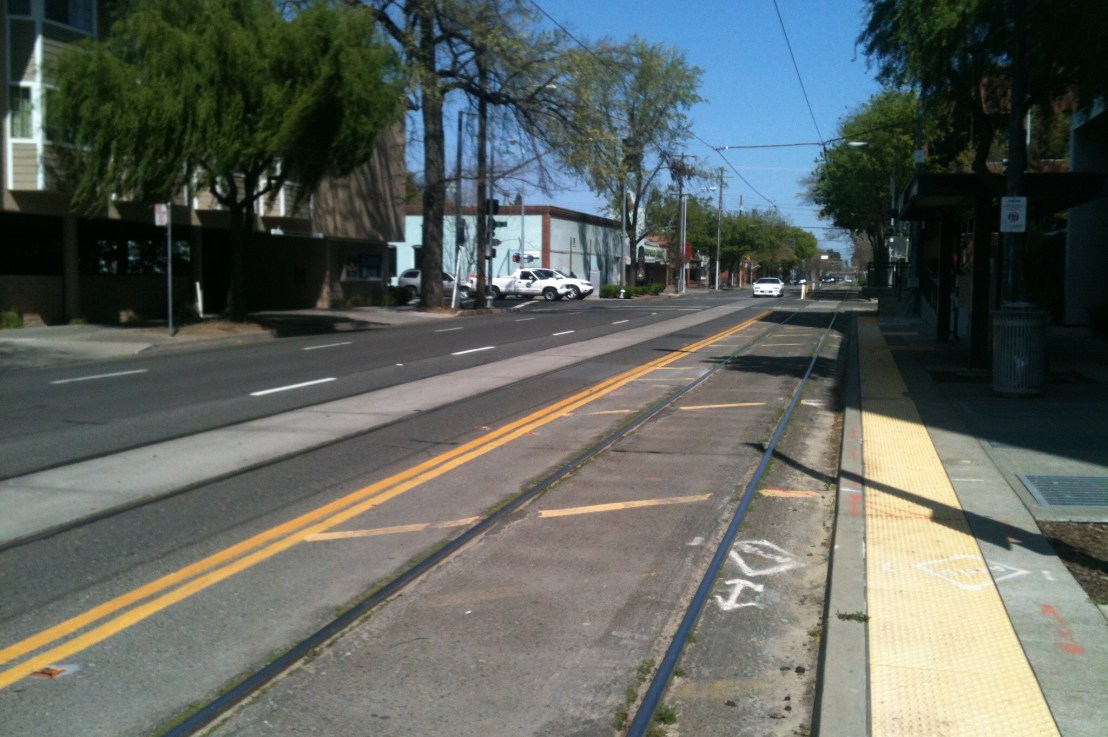
Two light rail track run on 12th St from K St in the south to just short of Richards Blvd in the north, where a single track carries light rail over the Hwy 160 Bridge into Del Paso Heights. This single track pinch point is a serious problem, but will be addressed in the future, as this series is about light rail in downtown.
Except for the block-long merge at the north end, the northbound Blue Line tracks are in a dedicated lane while the southbound tracks are in a lane shared with motor vehicles. Southbound light rail trains often get stuck behind cars, particularly at the J St intersection where cars turning left onto J have long waits while pedestrians cross. While this location could be mitigated by an exclusive pedestrian phase, the issue exists at nine intersections in the section, all of which have the same left-turn delay issue though not as severe. It seems from observation that light rail may even have signal prioritization at two locations, but that does no good if the train is stuck behind cars.
There are two solutions to this delay:
- Make the southbound tracks a dedicated lane, as well as northbound. This would probably have an impact on motor vehicle traffic during the congested morning commute into downtown, though as is true with all lane-reduction projects for whatever purpose, the impact is much smaller that a percentage reduction in number of lanes would suggest. 12th St, which is one-way southbound until J St, is four lanes north of C St and three lanes south of C.
- Route the southbound tracks on a different street. The only other through street, running under the railroad tracks, is 16th. The distance between those two streets, four blocks, would make for an awkward system, with Riders uncertain about where to go to reverse directions. A one block separation, such as 7th and 8th, is much easier to understand. So running tracks on a separate street would require a new tunnel under the railroad tracks. 11th and 13th streets are the candidates. Each has benefits and issues, as both streets are not continuous, both alignments would pass through some private property, and both need to get under the railroad. Though the railroad right of way is very wide here, and the 12th St street underpass very long as a result, most of this is unused, a remnant of tracks and a yard no longer used. This option would have much higher costs than the first, as moving tracks to a new street, and the related utilities work would be expensive.
It should be noted that there have been proposals from a number of people that light rail alignment in downtown should be reconsidered, as the current alignment reflects destinations and patterns when the routes were designed in the early 1980s. For example: there may be too much overlap between Gold and Blue lines; the streetcar, when/if it comes, may argue for different light rail alignment and transfer points; and there are significant employment centers not close to existing alignments. North-south alignments have been suggested for 16th St and the rail corridor between 19th and 20th, which is already used south of R St. However, those challenges and solutions are beyond the scope of this particular series of posts on light rail in downtown.
Next up: O St transit plaza
 Sacramento Transit Advocates and Riders (STAR)