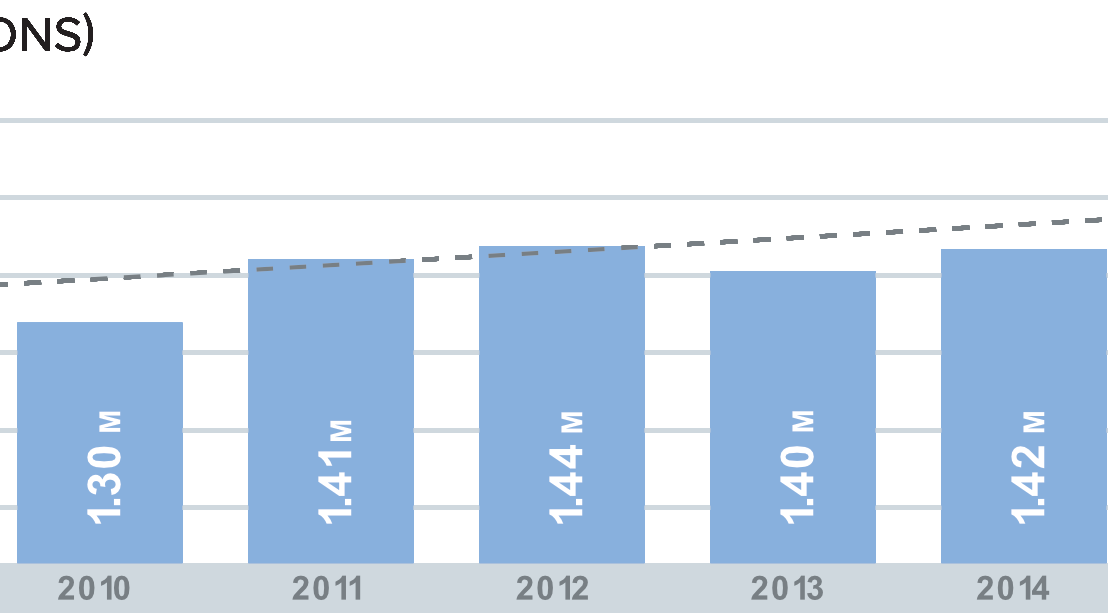
 It has been claimed that there was a major drop in ridership of the Capitol Corridor trains at Sacramento Valley Station when the platforms were relocated from close to the historical station to new platforms about 1000 feet further away. Data provided in Capitol Corridor annual performance reports indicates a drop of about 300,000 passengers per year between Fiscal Year (FY) 2013 and FY2014, a very concerning drop. A graph of this data at right. Fiscal years are labeled by their ending year, so FY2013 is July 2012 to June 2013. The new platforms opened in August 2012.
However, Capitol Corridor Joint Powers Authority (CCJPA) has said that the drop is largely an artifact of the change in 2013 from paper ticketing to eTicketing, which revealed that monthly passes, a significant part of ridership, were showing up as high ridership when they were actually lower.
What happened is that prior to the adoption of eTicketing, Amtrak assumed the usage of monthly tickets was far higher than actually happened. The use of eTicketing revealed that monthly ticket holders did not ride every day of the work week as was the assumption. As soon as they got real usage data, it revealed overall there was roughly a 17% drop in ridership. – email from CCJPA
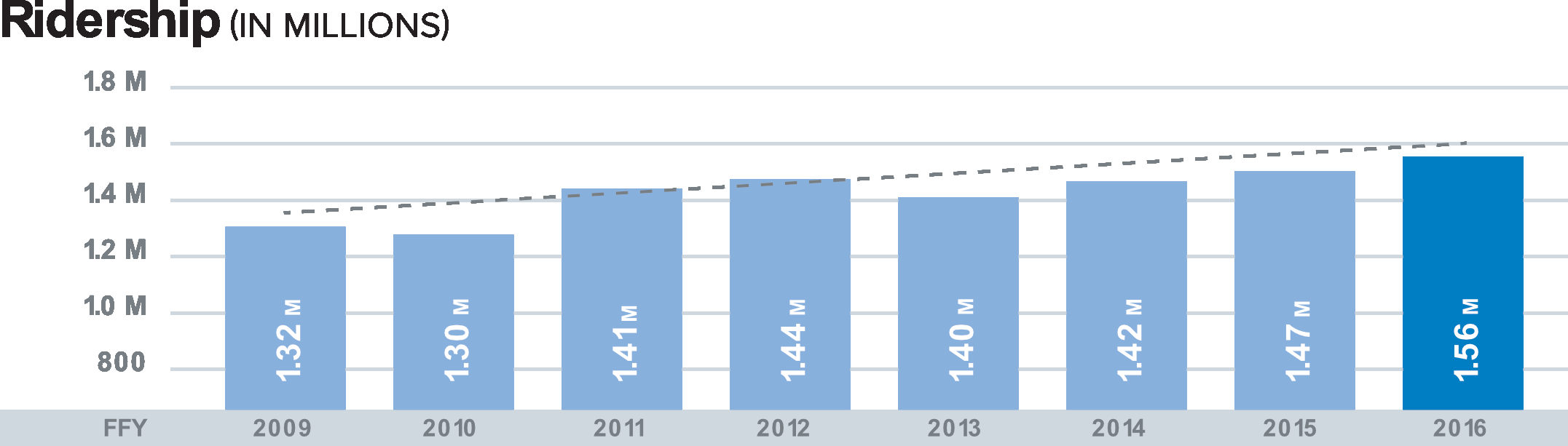
A chart showing corrected numbers, taken from the CCJPA 2016 Performance Report is below. This chart shows a much smaller drop, of about 40,000, between FY2012 and FY2013. Though this drop might be attributable to the platform relocation, several other factors such as gas prices, roadway congestion, fare prices and categories, and the availability of Megabus, may have also had an influence.
Platform location is a significant issue for the station. While relocation made some things better, it made others worse, and it also foreclosed (temporarily or permanently) some options for connectivity. Now that the City of Sacramento is continuing its Sacramento Valley Station planning under Phase 3, connectivity questions become critical.
Two particular issues stand out for the new platforms:
- The platforms are further from the station, meaning longer walk distances for passengers. This has been mitigated by offering shuttles from the station to the platforms, supposedly for people needing the assistance, but often used by others simply not wanting to walk. The platforms are therefore subject to shuttle carts coming and going, inconveniencing people waiting on the platforms. Some of the shuttle drivers are less than polite to other people.
- The platforms are now further away from light rail, the SacRT Route 30 bus, the Amtrak Thruway buses, and the taxi waiting area, reducing the ease of multi-modal connectivity. The plan was to resolve these issues by moving light rail and the bus area closer to the platforms, but unfortunately the city and SacRT failed to plan ahead of time for this, and it is not clear when or even if this will be solved.
That being said, there are three major advantages to new location:
- The passenger platforms are no longer shared with freight trains, making for a safer and more pleasant platform environment.
- The platforms are long enough to accommodate all trains using the station, including the longer long-distance California Zephyr and Coast Starlight. The old platforms were not. They are also long enough to store the shorter Capitol Corridor and San Joaquins trains at night and while awaiting use.
- The extremely sharp bend coming into the station from the east, which engendered squealing wheels that could be heard a mile away, has been eliminated.
The city missed an opportunity to create level boarding platforms, but the new ones are closer to level than the old ones, and the they could be raised in the future.
STAR will be posting a lot more about Sacramento Valley Station, so stay tuned.
 Sacramento Transit Advocates and Riders (STAR)