SacRT is proposing some services changes to take place in September 2022, and seeking public comment (but only through May 1, sorry for the late notice).
In general, STAR supports these service changes. We see it as part of the continuing evolution of the transit network that was reset with SacRT Forward network redesign in 2019. In general, STAR supports improving service (frequency or span) on existing successful (high ridership) routes, rather than changes to try to improve low ridership routes, unless it is clear that changes would significantly improve that route.
The service change document lays out changes to several of the fixed bus routes. There are some improvements to the high frequency and high ridership routes 51 Stockton/Broadway and 81 Florin. The commuter routes in the 100 series (except 142 Airport) will continue to need adjustment once or twice a year based on the commuter patterns that develop during and after the pandemic. We encourage riders to look at the routes they use and comment to SacRT on whether the changes improve or reduce the route and service you use.
STAR does have suggestions about route numbers and the system map that should be implemented along with service changes:
- Renumber routes so that the route number gives an indication of frequency. For example, numbers 1-99 are high frequency, 101-199 are medium frequency, etc. An idea for numbering is provided in renumber the routes!
- Remove the F (Folsom) and E (Elk Grove) designations by giving these routes unique numbers
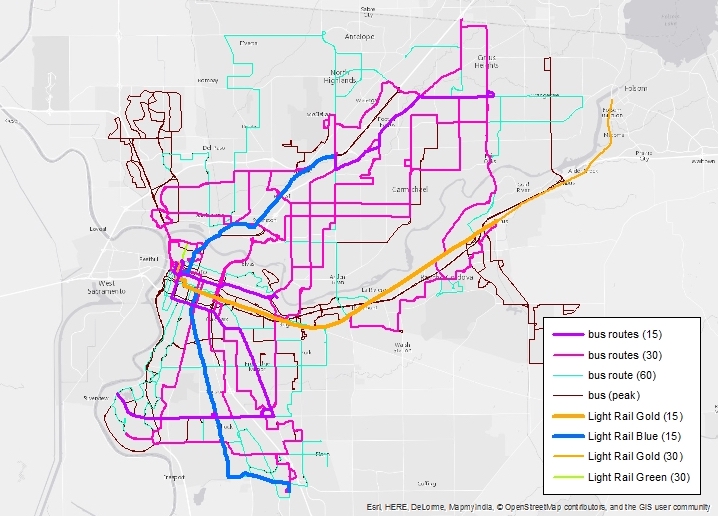
- Revise the system map so that it distinguishes high frequency (15 minute), moderate frequency (30 minute), and low frequency (45-60 minute) routes. Light rail should continue to be highlighted, but not much more prominently than high frequency routes. The legibility of system maps, whether presented as a document, or presented in online or app transit tools, is key to making the system usable for everyone.
As an example for a system map, the following one developed by STAR in 2016 shows high and medium frequency with a different color than other frequencies. It is not up to date, but will provide the idea. Line widths and color can be used to indicate frequency.
 Sacramento Transit Advocates and Riders (STAR)