From NACTO Transit Street Design Guide – Platform Height:
Platform height affects ease of boarding; raised platforms enable easier, more accessible passenger boarding and alighting by decreasing step-down distance and gap between vehicle floor and platform. Level and near-level platform stops can also increase route efficiency, allowing vehicles to enter and exit stops more quickly.
Near-Level Boarding
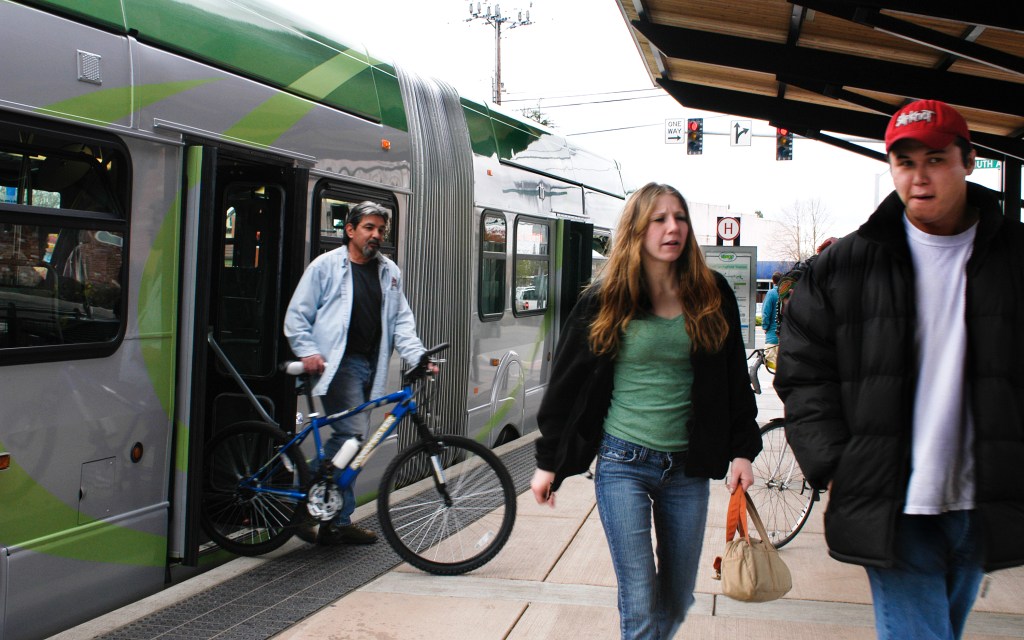
Near-level platforms place the curb height at 8–11 inches
Near-level platforms allow faster boarding, and are compatible with most existing transit fleets.
Allows an operator to either kneel the bus or deploy a short bridge plate or ramp. Short bridge plates, often used on streetcars, require far less space than a full-height bus ramp.
Bridge plates rising less than 3 inches require 1:4 max slope, or 12 inches of length for 3 inches of rise. For 3–6 inches of rise, 1:6 max slope is required, and 1:8 max slope is regulated for 6–9 inches, increasing the length required up to 72 inches for a 9-inch rise. Shorter rises allow more compact ramp deployment. – “Part 38—Accessibility Specifications for Transportation Vehicles.” ADA Accessibility Specifications. Federal Transit Administration, Washington, DC: 2007.
Near-level platforms are suitable for side and center boarding islands, boarding bulbs, or sidewalk stops with sufficient width to provide a raised area. Provide ADA-compliant ramps to achieve desired height leading to the boarding pad. Ramps should not impede pedestrian paths or crossings [49 CFR §38.23(c), §38.83(c)].
Detectable warning strips must be installed along the edge of the boarding platform, except when part of an existing sidewalk.
Level Boarding

With level boarding, the platform height matches the floor height of transit vehicles (for on-street low-floor vehicles, typically 12–14 inches).
Can apply to light rail, streetcar, or retrofitted low-floor buses.
Many agencies have transit vehicles that are incompatible with level boarding platforms: some vehicle design geometry may prevent them from pulling to the curb
Transit vehicles must be able to pull in very close to the curb to eliminate the gap (see Transit Curbs).
Ramps are not deployed and vehicles do not kneel, reducing delay and adding convenience.
Detectable warning strips or another detectable surface must be installed along the edge of the boarding platform.
 Sacramento Transit Advocates and Riders (STAR)
One thought on “level boarding?”