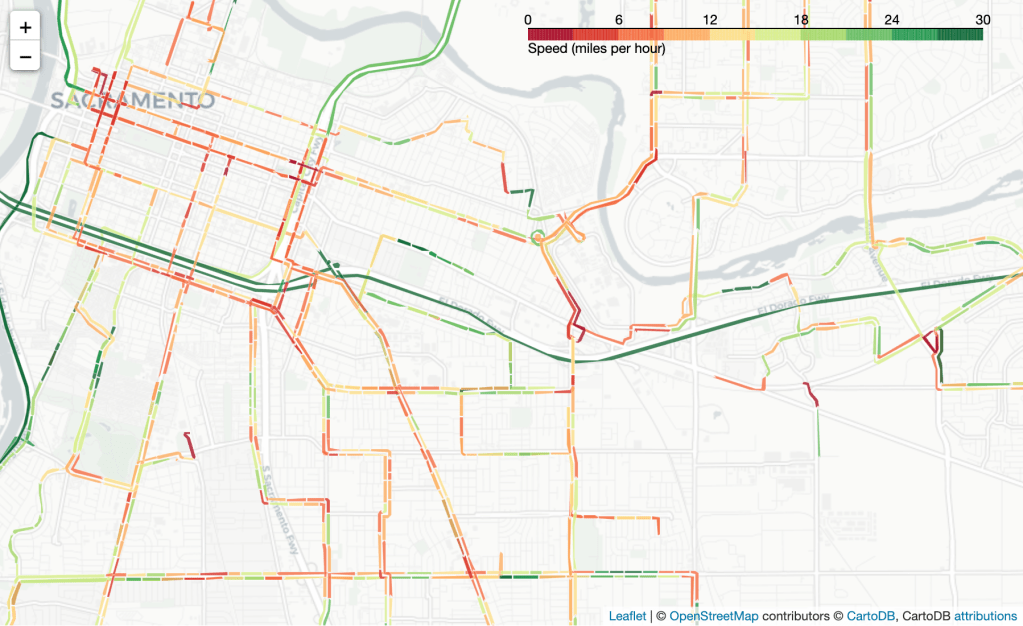
Caltrans, through the CalITP (California Integrated Transit Project) has made Transit Speed Maps available, showing bus speed for many transit agencies, including SacRT. The data is from a single date, February 8, 2022, but is probably representative of weekdays.
- In the morning, several routes are listed as slow, but the most important are 51 Stockton/Broadway at 9.2 mph northbound, and 38 Tahoe Park at 9.0 mph eastbound.
- In the midday, the most important are 30 J St, eastbound at 8.5 mph and westbound at 8.7 mph, and 38 Tahoe Park, westbound and westbound at 8.7 mph.
- In the afternoon, the important ones are 51 Stockton/Broadway, northbound at 8.7 mph, and 30 J St, westbound at 8.1 mph and eastbound at 8.5 mph.
Why are these the important ones? They are the among the highest ridership bus routes in the system (usually 51, 81, 1, 30, and 38).
The maps do not distinguish between types of routes (fixed routes at different frequencies, commuter routes, neighborhood routes), or even different transit agencies which overlap service areas. A lot more analysis would be required to determine how to make best use of the data, but it is a start.
What stands out is that SacRT’s most important and highest ridership route, 51 Stockton/Broadway, is very slow northbound at two times of day. This is the service that would most benefit from speed increases. The city has offered some improvements to Stockton that would increase travel times, but it is unknown when those might be implemented, and these fall short of real bus rapid transit (BRT).
Average bus speeds of course include dwell time at stops. Slow board and unboarding can do as much to slow buses as traffic on the street, particularly when the bus is forced to pull out of and then re-enter traffic. STAR’s policy, which should be SacRT and City of Sacramento policy, is that buses should never pull out of traffic except at timed points where the buses may need to wait to catch up to the schedule. It is likely that the reason CalITP is interested in this topic is that universal fare readers on all transit vehicles would reduce dwell time and thereby speed buses.
 Sacramento Transit Advocates and Riders (STAR)