In the Congestion Improvement Projects, Transit and Rail Congestion Improvement Projects section, the text of the Measure A 2022 Transportation Expenditure Plan says: “In coordination with the Capital Southeast Connector Joint Powers Authority, design, plan and construct a transit component, such as a bus rapid transit service, along the Capital Southeast Connector corridor to mitigate greenhouse gas (GHG) emissions and meet air quality targets. SacRT will match $40 million in revenues generated by this Measure with $80 million in state and federal funds for a total of $120 million in resources toward this goal. The project would consist of providing signaling and a bypass at critical connector sections to improve service, lower travel time, and reduce GHG impacts.”
The Capital Southeast Connector seems an unlikely place to run transit. The new freeway will connect Folsom to Elk Grove. There are two types of uses this connection might get: long distance commuters between the two cities and their purported jobs (though Elk Grove really has very few jobs, the lowest jobs to housing ratio in the county), and freight traffic bypassing Hwy 50. But the county and Caltrans are right now spending $460 million to increase the capacity of Hwy 50. And as soon as they get done with that project, there will no doubt be additional and expensive projects to expand the capacity of other sections of Hwy 50. Once transportation agencies commit to the fallacy of reducing congestion through capacity expansion, they can’t stop because every project will become congested in a few years with induced travel.
The housing that measure proponents intend to spring up along the route (it is greenfield developers who are funding the ballot measure) will be almost entirely high end housing. These are not people who tend to use transit. Instead, they will drive. Long distance commuting plus freight plus many new commuting drivers will equal a congested roadway. The developers will be back at the public trough asking for more money to further expand the freeway. Of course commuting is only about 15% of driving trips, but other trips for other purposes, or for no purpose, will increase along with commuting trips.
Take a look at the Connector map below. See all that white area along the route? That is the area that greenfield developers intend to fill with low density housing and development. More spread out development means more vehicle miles traveled and more greenhouse gas emissions (GHGs). And higher transportation expenses for everyone who is forced to drive to reach destinations. Measure A is a plan for forced car ownership.
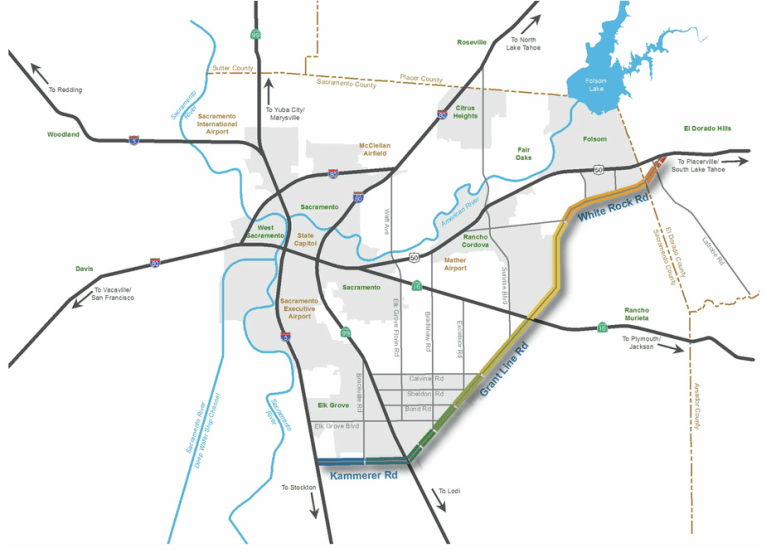
The language locks SacRT into providing transit along the Connector route, even though it is unlikely they would otherwise decide to provide service there. It it too long a distance, passing through low density areas, to make sense for transit. Transit is effective with higher density and shorter trips. It is effective in cities, not low density sprawl.
STAR finds it particularly inappropriate that Measure A values transit, not as a transportation mode, but as mitigation. It is saying: ‘If we are producing greenhouse gas emissions (GHGs) and pollution from motor vehicles, which we are, then transit can make up for that’. But that only works if transit gets people out of cars and onto buses. Who among the residents of Folsom, Rancho Cordova, Elk Grove, or the new greenfield developments will be using transit? Very, very few, we suspect. It is instructive to think about existing developments. North Natomas has a very low bus ridership per person. In fact the commuter shuttles where dropped and are unlikely to be restored because they weren’t getting much use, before as well as during the pandemic. And North Natomas is a middle income area, not the high income area that the southeast greenfield developments will likely be. Parts of Rancho Cordova south of Hwy 50 have both community shuttles and a bus route. They don’t get much use, and the fact that they exist is because of the property tax subsidy that was required as part of the development agreements. Measure A does not envision any property taxes devoted to transit for the Capital Southeast Connector. Once the infrastructure is done, the operations expense will probably fall entirely to SacRT.
Measure A is bad news for transportation, and bad news for transit. The Capital Southeast Connector is climate arson, and transit cannot save it from being so.
 Sacramento Transit Advocates and Riders (STAR)