The City of Sacramento will be installing more protected bike lanes (properly called separated bikeways, and also often called cycletracks) along streets with bus service. Near-term examples include Stockton Blvd and Northgate Blvd, and extensions of the existing lanes in the central city. The city has recognized, at least verbally, that transit is a significant solution to GHG/VMT reduction and traffic safety. However, the designs proposed often retain priority for motor vehicle travel and parking over transit.
STAR’s policy is that buses should not pull out of traffic, except at timed stops where it may be necessary for the bus to pause in order to get back on schedule. This is not the usual circumstance, but does occur. The default should be that buses stop in the travel lane. Buses that pull out are subject to considerable delay while trying to merge back into traffic, and in fact dwell time at stops is a major factor in slowing bus speeds. There are also safety issues with the pull in and pull out movements, as there would be with any merge movement. But there must be a curb at which the bus stops, in order to load and unload people with mobility devices. Curb extensions for bus stops are the solution on streets without protected bike lanes. But for streets with protected bike lanes, the stop is not at the traditional curb, so this requires a different solution.
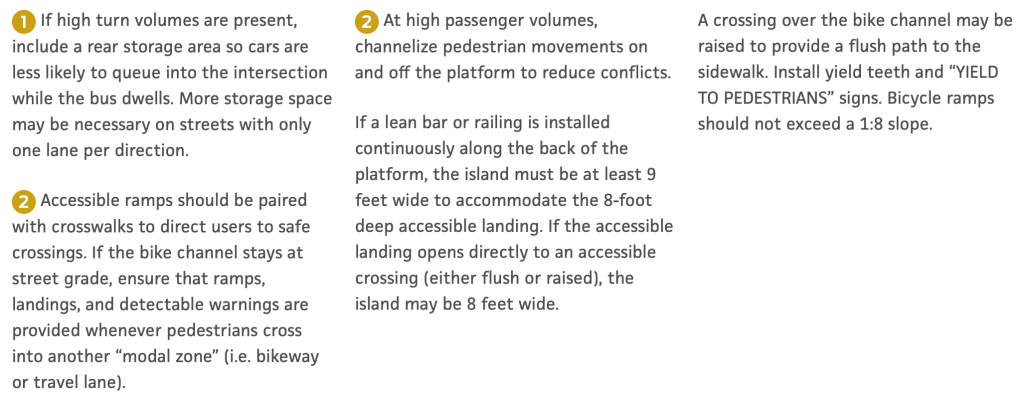
Though STAR does not have a policy, we believe that transit boarding islands with bikeways between the island and the sidewalk are should be considered at every location. The diagram below, with the text following, is from the NACTO Transit Street Design Guide, Side Boarding Island Stop page. The guide can be purchased, but is also available online.
The boarding island is wide enough for standard bus stop amenities including benches and shelters. People with mobility devices are loading and unloading to the curb, just as if a sidewalk curb, and in fact the island can be somewhat higher than the curb to ease boarding. The pedestrian crossing of the bike lane is marked and signed so that clear that pedestrians have the right of way.

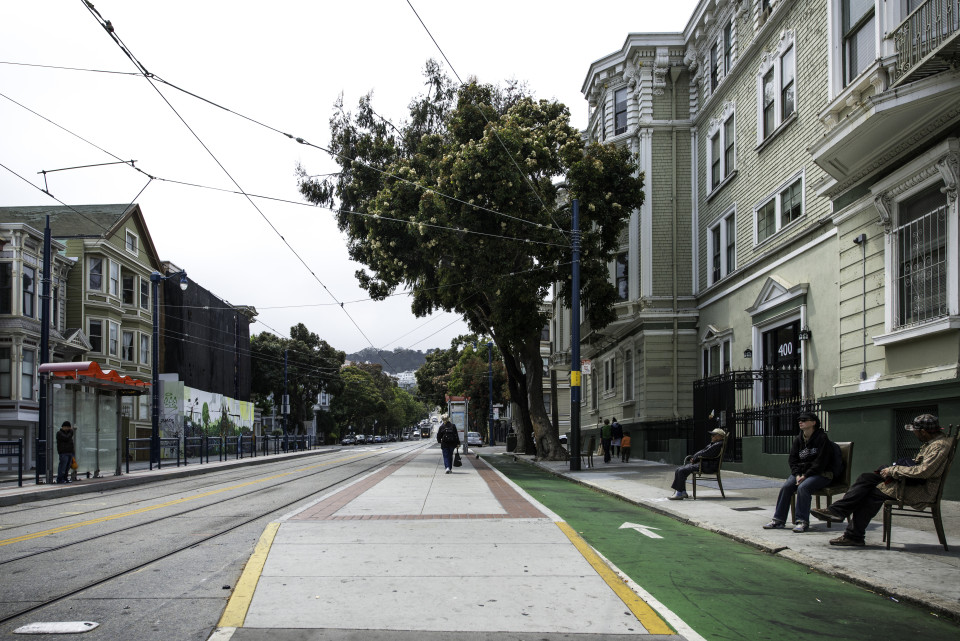
The photo below is from the NACTO guide, showing a bus boarding island with bike lane behind, on Church St in San Francisco. In this case, there is a ramp down to street level, to a crosswalk with ADA ramps near side and far side. In this case the users is more likely to want to access the crosswalks than the sidewalk. In other cases, access to the sidewalk would make more sense.
 Sacramento Transit Advocates and Riders (STAR)
One thought on “bus stops & protected bike lanes”