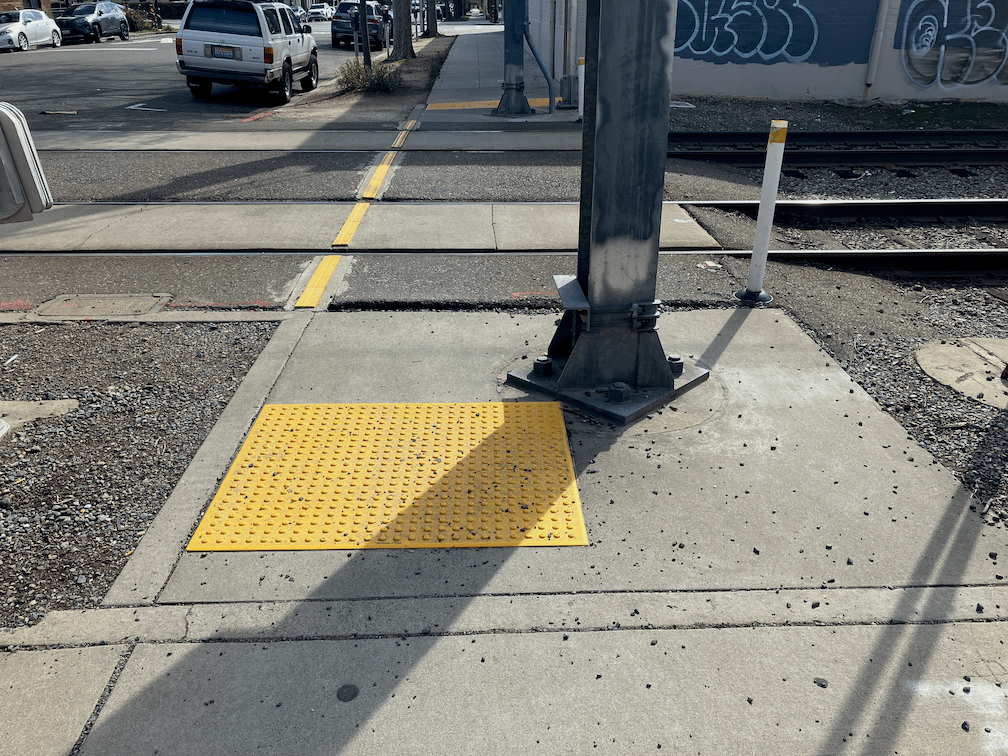
The overhead wire (catenary) poles installed on 14th Street and the light rail tracks between P Street and R Street narrows the sidewalk below that required by building code. The 2022 California Building Code, Chapter 11B, Division 4, Accessible Routes, says: “The clear width for sidewalks and walks shall be 48 inches minimum”. Of course, the poles were placed at a time when codes may not have been as restrictive. Nevertheless, this instance of sidewalk blockage should be corrected.
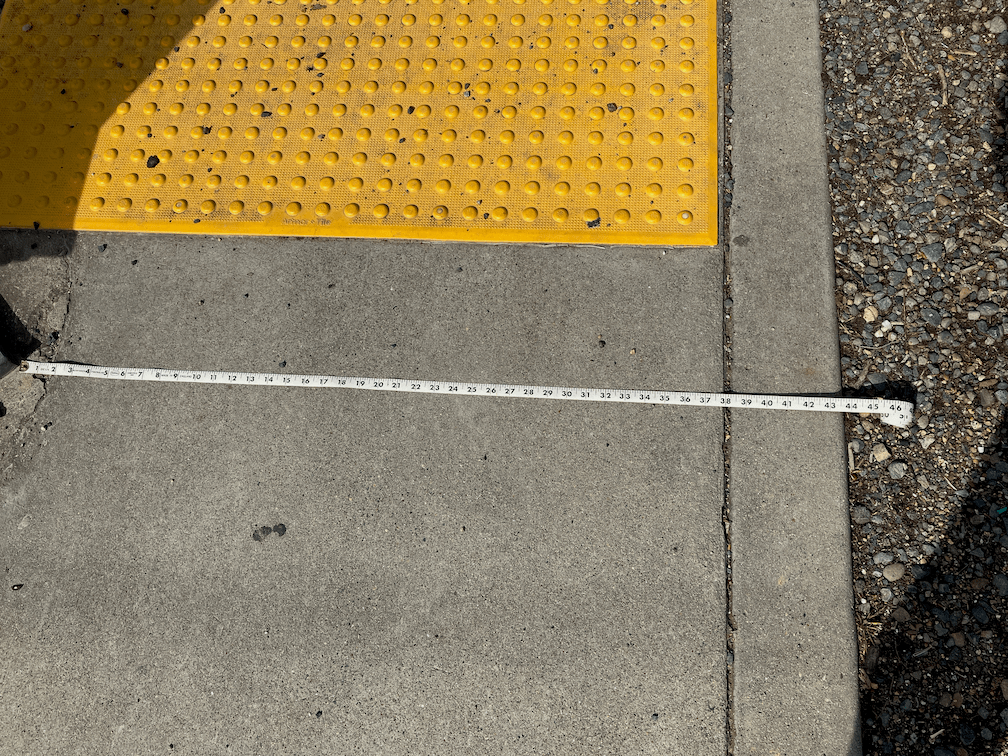
Notice in the first photo that the detectable warning strip (yellow bumps), 46 inches wide, is wider than the sidewalk. The second photo shows a measurement of the sidewalk width, 43 inches. Though the building code allows a curb to be part of the width, it is only when there is no joint between the sidewalk and curb. In this case, there is a joint. The first photo also shows that the asphalt used as sidewalk (it should be concrete) has buckled up against the sidewalk, presenting an additional barrier for ADA.
It is not possible to simply move the sidewalk to the east, avoiding the poles, because the railroad crossing arm mechanism is there (just visible on the left of the photo). Would it be less expensive to move the crossing arm mechanism or the overhead wire pole? I don’t know, but one or the other needs to be done. And the quality of the sidewalk though this area needs to be corrected.
We love light rail! But when light rail infrastructure makes mobility for disabled people harder, and illegal, it must be fixed.
 Sacramento Transit Advocates and Riders (STAR)