At the September 25 meeting of the SacRT Board of Directors, agenda item 7.1 was ‘Presentation on Ongoing Projects and Initiatives’. This is the third of four presentations to the board; the first two were in July and August, and the last will be in October. The two prior presentations are available: July, August. The SacRT SmaRT Ride program was addressed in July as agenda item 7.1, not part of this ongoing series.

The agenda item 7.1 with presentation is here.
The fare free analysis was detailed, but focuses on costs and not on savings or benefit to riders. Fare recovery, the portion of expenses covered by fare income, is only about 7% of the operating budget for SacRT. Two scenarios were analyzed, scenario A will a projected cost of $42M and a ridership increase of 3.1M, and scenario B with a cost of $70M and a ridership increase of 9.2M. Though the base ridership was not provided, annual ridership pre-pandemic was about 20.9M, so these represent an increase of 15% and 44%. The analysis projected that a huge increase in law enforcement would be necessary. Though it claimed that reduced costs resulting from no fare enforcement were included, no data was provided. It is pretty clear that the analysis was developed in order to show that free fares should not be implemented.

STAR’s comments on the fare free analysis presentation were:
- STAR does not have a position on free fares, but supports the exploration of free fares and is glad that this is moving forward after being requested for years
- The analysis focuses on the costs of free fares, but does not address the savings, such as:
- not having to purchase and maintain fare payment systems and physical infrastructure
- improved dwell times for buses, leading to faster route times and therefore more efficient operations with fewer buses and fewer operators
- security staff able to focus on unacceptable behavior rather than fare enforcement, so large increase in security staff may not be needed
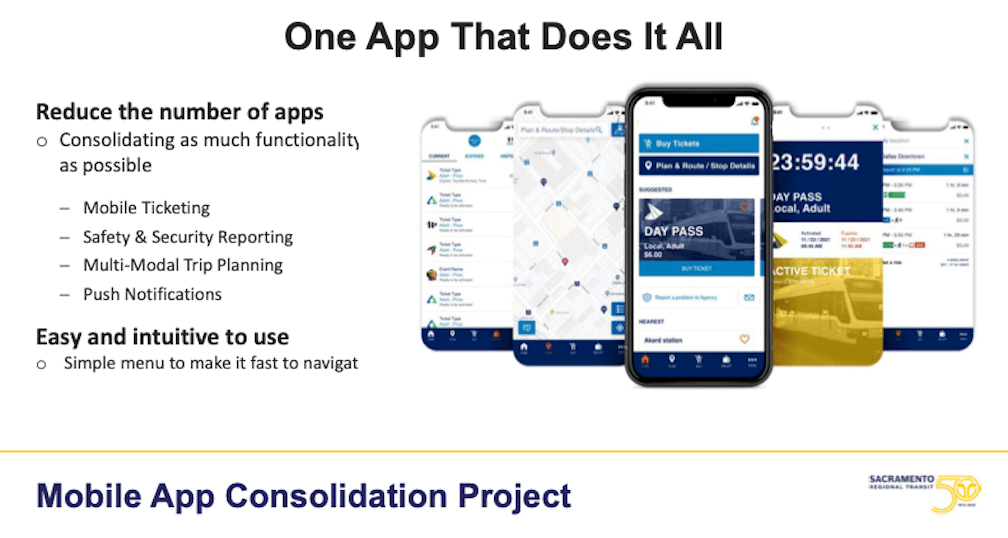
The second presentation of interest is ‘Leveraging Technology to Enhance the Customer Experience’. The first topic was ‘Improved Website’, addressing several desired characteristics, but neglecting to mention search capability. The current website does not offer search. Will the new one? The second topic was ‘Passenger Announcement System & Train Technology Refresh’ addressing the deplorable lack of communication to riders related to light rail timing (theoretical schedules are displayed, but no real time information) and delays. The mix of old and new trains on the Gold Line platforms will require announcements well ahead of time about the next train arriving, and the current system has no capability for that. The third topic was ‘Mobile App Consolidation Project’, to merge the five existing disparate apps into one. The multiplicity of apps is one of the frequent complaints that the transit advocacy organizations hear from riders. The fourth topic was ‘Mobile Ticketing/Contactless Payment’. Connect Transit Card was mentioned, but not an upgrade to the poorly designed and outmoded method. Tap 2 Ride contactless credit card payment was discussed, but no mention of when it would be implemented systemwide, nor when discount fares would be implemented. The fifth topic was ‘Customer Service/Safety/Facilities Reporting’ the sixth ‘Multi-Modal Trip Planning’ and seventh ‘SmaRT Ride Integration’.
STAR’s comments on ‘Leveraging Technology to Enhance the Customer Experience’ were:
- STAR supports app consolidation; the many apps are a source of confusion for riders
- SacRT does not have a good track record for developing their own apps or purchasing apps from vendors; the apps have largely been a failure
- TransitApp should be seriously considered; most transit agencies already recognize TransitApp as their preferred trip planning app, such as all agencies in southern California, Portland, and Seattle
- Some agencies also use TransitApp for fare payment
- STAR supports contactless on-board payment via credit cards (Tap to Ride), but is disappointed that disabled and senior fares have not been implemented; Monterey-Salinas Transit implemented these fare discounts about two years ago
- Connect Transit Card must either be modernized or phased out, as it is old technology that is difficult to maintain, and often doesn’t work
 Sacramento Transit Advocates and Riders (STAR)