Note: SacRT refers to its on-demand micro-mobility service as both SmartRide and SmaRT Ride; I’m using SmartRide in these posts. SmartRide is still considered a pilot program, though it has been in operation for almost six years.
Operations Expenses
The SacRT board received an update on the SmartRide program in July 2023, including changes to zone boundaries and hours of operation starting August. This was engendered by a continued but reduced funding from Sacramento Transportation Authority (SacTA) Measure A. SacTA provided three years of operations funding, fiscal years 2024 through 2026 (July 2023 through June 2026), but at a lower level than the earlier years. You can read the board document (https://star-transit.org/wp-content/uploads/2023/12/sacrt_2023-07-24_agenda-7-1_smartride.pdf), if you are having a hard time sleeping. A key sentence from that document is: “However, with the failure of Measure A at the ballot in November 2022, SmaRT Ride remains without a permanent full-funding source”.
The SmartRide budget presented for the three years is:
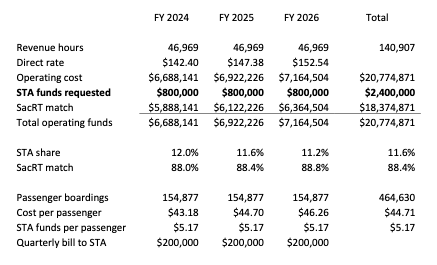
The overall FY 2023 (July 2022 through June 2023) budget showed $11.1M for SmartRide, so the 2024 budget $6.7M represents a significant reduction. I’ll use that $6.7M number for discussion, though it is budgeted to increase to $7.2M. Realize that SacRT would budget significantly more if it could. SacRT has expressed an interest in getting back to the previous levels and further expanding.

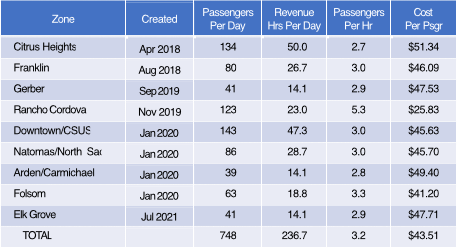
The board document also provides a chart of cost per ride, below. These cost are in line with figures reported by other transit agencies with on-demand micro-transit services, and in line with the $44.71 average included in the SmartRide budget. Paratransit services, also operated by SacRT, have a cost of about $60 per ride, the difference being that paratransit rides are more often single people.
Fixed route bus and light rail services are generally reported by per passenger mile traveled (PMT ‘the cumulative sum of the distances ridden by each passenger’) or vehicle revenue miles (VMT ‘the miles that vehicles are scheduled to or actually travel while in revenue service’), and not per rider or trip, but a scan of costs from different systems indicates a cost of $4 to $10 per ride. SacRT fares for all regular services are $2.50 adult, $1.25 reduced, and youth free. Taking high values, an on-demand micro-transit ride costs 4-1/2 times what a fixed route ride costs. Remember that, 4-1/2 times.
All of these expenses are for operations, which includes drivers, fuel, maintenance, maintenance facilities, and administration. The most expensive part of operations, for any type of service, is the vehicle operator. As it should be, drivers deserve good pay. But a fixed route bus driver may be carrying up to 30 or more people, while an on-demand driver is carrying up one to six people, and is spending significant time either sitting waiting for the next ride request or driving empty to the next pick-up.
Capital Expenses
The SmartRide on-demand micro-transit also has capital costs, primarily the cost of the vehicles. There are 45 vehicles dedicated to the service, though the new program seems to indicate a reduction to 33 vehicles. The entire bus fleet, as of July 2021, was ‘186 buses powered by compressed natural gas (CNG), six zero emission electric buses, 26 shuttle buses powered by CNG, nine zero emission electric shuXle buses, and 120 ADA paratransit vehicles’; we haven’t been able to find current fleet info. Most SmartRide vehicles are cut-away vans (commercial vans modified with passenger cabs) and some are more traditional passenger vans, most or all electric. Some of the cut-aways may have been repurposed from paratransit vehicles. All these program vehicles are much less expensive that regular fixed route buses, which are about $225K each. We have not been able to find a table of vehicle types and costs for the SmartRide fleet. Of course any type of bus will need to be replaced over time, which is an additional capital cost. The fleet is fairly new, so replacement may not be an large cost during the three years. But if the pilot or program is continued beyond that, capital costs for vehicle replacement will be significant. Cut-away vehicles do not tend to last very long. If you have ridden a cut-away, you will recognized the common nickname for them, which is rattletraps. One of the reasons that regular transit buses are expensive is that they are built to last 12 years or more, and/or 250K miles or more. Not so, the SmartRide vehicles.
Next
Part of SacRT’s claim for SmartRide is that it does or could serve disadvantaged communities in ways which fixed routes can’t. It is certainly true that parts of the SacRT service area (which is largely but not entirely coincident with the Sacramento county boundary) are not well served by fixed route services, or even at all, but are those the areas that need or deserve SmartRide?
 Sacramento Transit Advocates and Riders (STAR)
2 thoughts on “SacRT SmartRide costs”