Note: Other Truxel Bridge posts are available under category ‘Truxel Bridge‘. Other Green Line posts are available under category ‘Green Line to the Airport‘.
The original reason for the Truxel Bridge was to carry the Green Line to the Airport light rail over the American River, on its way to south Natomas, north Natomas, and Sacramento International Airport. The earlier name of the line was DNA, Downtown-Natomas-Airport. This was the concept that the American River Parkway Plan and SacRT developed and supported. The bridge was also to carry walking and bicycling. The city decided that motor vehicle traffic was a critical addition, and captured the bridge idea from SacRT. Though SacRT is not opposing the city bridge proposal, it has never, so far as known, approved this project.
The map below (pdf) shows the routing of the Green Line Extension, as proposed. The Green Line currently ends at 7th & Richards/Township 9 station in the River District. The map breaks the extension into three segments. This detail will be explored in future posts, but it reflects STAR’s doubts about whether the entire line will ever be built, due to cost and low ridership, and the desire to consider the benefits of each segment separately from the whole.
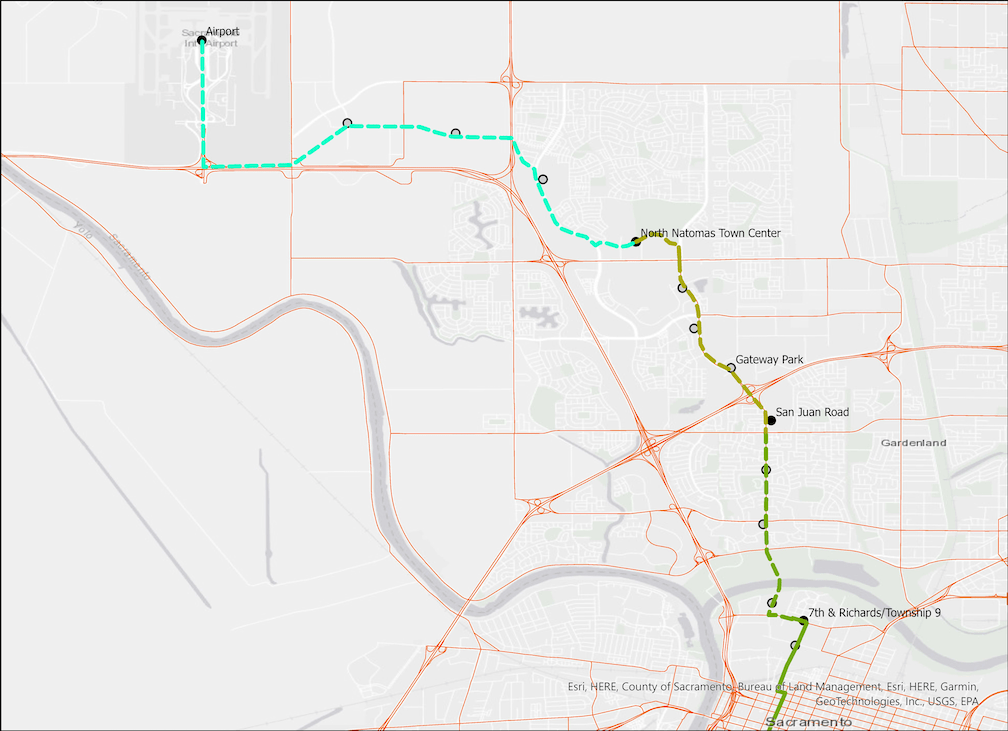
If light rail is to cross the American River, the Truxel alignment is probably the logical place for it to cross. An alignment with Northgate Avenue has also been suggested, however, this alignment has somewhat less housing along it than Truxel and Natomas Blvd (Truxel Road turns into Natomas Blvd when it crosses Del Paso Road in north Natomas), and is mostly warehouse, commercial, and low density office parks to the north of I-80. Successful light rail depends to some degree on employment centers, though Natomas has no regionally significant employment centers, and most importantly, housing density.
And if it crosses the river, how far should it go? The three segments shown on the map show alternate terminations. The current bus service to the airport, a combination of SacRT Route 142 and Yolobus 42A/42B, does not have high ridership, in part because it is not frequent enough, it does not match worker schedules well, and the customer base for Sacramento flights are not generally transit using people. Would light rail have higher ridership? That is unknown, but not likely.
The reason for raising the question of whether light rail will go north of the American River is that many people are questioning whether the Green Line to the Airport project is either possible or the best expenditure of funds. In particularly, the two city council members that represent areas to the north, Lisa Kaplan, District 1 (mostly north Natomas), and Karina Talamantes, District 3 (mostly south Natomas) are on record as saying they are not interested in waiting 40 years for light rail, but want BRT (bus rapid transit) now. Though a direct route across the river for BRT would be optimal, BRT is much less affected by route choices than light rail, and it might be acceptable for BRT to use the I-5 bridge for a small part of the route. If so, the bridge may not even be needed for transit.
STAR will provide some additional posts on Green Line to the Airport, but this serves to address the question as it related to the Truxel Bridge project that the city is proposing. It is an open question.
 Sacramento Transit Advocates and Riders (STAR)
> the customer base for Sacramento flights are not generally transit using people
How do we get more transit-using people? Perhaps by having better transit? Perhaps if the transit isn’t very good, people won’t want to use it? I guess it’s easier to do nothing, but I’m surprised to read this kind of take from a transit advocacy group.
I ride the light rail and connect to 142 to and from the airport every time I fly (which, admittedly, is not often). The service improved dramatically once RT started offering the bus connection.
Prior to that, Yolobus almost caused me to miss a flight due to being dramatically late, with no explanation. After I waited for 40 minutes past its scheduled time, I finally gave up and ordered a Lyft. I likely would have missed my flight if I had kept waiting. I would imagine that most other people would have less tolerance for this kind of systemic failure than I have, and would not have attempted taking the bus again. Even in my case, I now plan my trips to avoid 42A/42B.
The point being, catching a flight is not just like any other transit need. It’s actually really important to be there on time. It seems to me that the light rail would be much better at meeting this need.
Not to mention, needing to lug one’s suitcase off a train and onto a bus to make the connection isn’t much fun either, especially for people who are older or have health issues.
As long as transit isn’t meeting people’s needs, of course people won’t use it. How self-defeating that seems, though.
LikeLike
ECOS letter to SacCity on Truxel Bridge: https://www.ecosacramento.net/wordpress/wp-content/uploads/bsk-pdf-manager/2023/01/2023-01-Jan-31-ECOS-LETTER-to-City-of-Sacramento-Truxel-Bridge-over-American-River.pdf
LikeLike