SacRT received a Federal Transit Administration grant of $77M to purchase hydrogen fuel cell buses and create a new bus maintenance facility at McClellan which will include a hydrogen fueling station. The grant and publicity highlights and keeps using the term “zero emission buses (ZEB)”. The buses are zero emission, at the point of use, but that is only part of the story of hydrogen.
From the SacRT announcement and flier, the entire fleet serving north Sacramento will be converted from compressed natural gas (CNG) to hydrogen fuel cells, 29 buses at this time. It is hard to understand how the buses serving the north area will be hydrogen, when almost every single SacRT route spans many areas of the city. The announcement does not say which routes, nor does it define the ‘northern areas’. The new bus yard at McClellan has space for 125 buses, which is an indication that buses will be moved out of downtown to McClellan and some location in south Sacramento that has long been discussed. Given that most routes pass through downtown, this means longer distances for buses to reach the beginning of their run.
There are several issues with this hydrogen fuel cell commitment:
- So far as we can determine, this shift from battery electric buses to hydrogen fuel cell buses never came to the SacRT board for discussion.
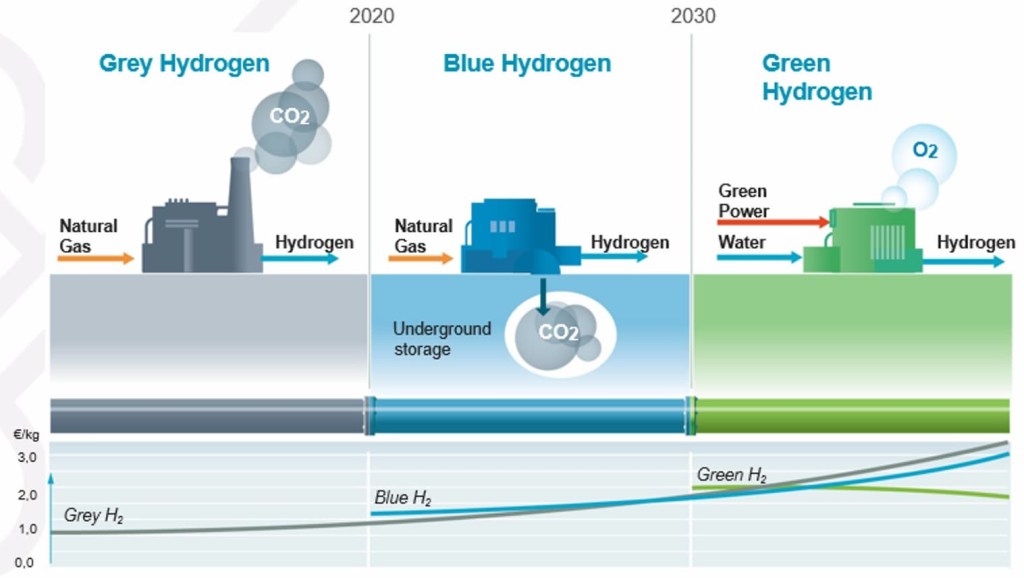
- Hydrogen is NOT zero carbon. In 2021, 98% of hydrogen was dirty or grey hydrogen, meaning that it was generated from fossil fuels: Hydrogen Fact Sheet: Production of Low-Carbon Hydrogen. While it is true that over time more and more hydrogen will be generated from electrolysis, at this time, it is almost as dirty as diesel fuel. Hydrogen is also not efficient, even if it is green. Electricity is converted to hydrogen energy, stored on board, and then converted back into electricity on the bus. Just as batteries must be carried on the bus (unless there are overhead wires), so must the hydrogen fuel. For an interesting read on the many possible ‘colors’ of hydrogen, see The hydrogen colour spectrum. We are using the simpler green, blue, and grey ‘color’ spectrum, shown in the graphic below.
- So far as we can determine, the grant application does not talk about types of hydrogen. That means SacRT could use any source of hydrogen, including that generated from fossil fuels.
- SacRT, and many transit agencies, have refused to even talk about overhead wires as the source of electricity for buses. Overhead wires power our light rail system. Overhead wires power a significant portion of bus routes in San Francisco, and some other cities. Overhead wires are not a solution for low or medium frequency routes, but should be considered for high frequency routes, in particular Route 51 Stockton.
- Fossil fuel companies are really pushing a hydrogen economy, not because they’ve suddenly become environmentalists, but because most hydrogen is generated from fossil fuels. They wish to retain their market domination. That does not mean hydrogen should not be part of our transit program, but that we need to be leery about claims made by commercial companies about hydrogen.
- Hydrogen fuel cell buses are not a mature technology. They have not been around for long, and are not used in very many locations. Battery electric buses have had issues as well, but are much further along the path of maturation and deployment.
STAR does not question whether hydrogen fuel cell buses should be or will be part of the mix of buses in the SacRT service area. They may be the solution for long routes that are not close to battery charging stations. What we are concerned about is that a headlong rush into hydrogen could be a mistake for SacRT, or any transit system.
Other posts on hydrogen: SacRT electric or hydrogen?
 Sacramento Transit Advocates and Riders (STAR)
2 thoughts on “hydrogen?”