This in part of a series of posts on the presentation given by Lisa Hinz at the SacRT Board Meeting on 2025-07-28. The audio accompanying the presentation slides is key to understanding them, so we recommend that you also view the meeting recording on YouTube.
Slides 6, 7 & 8 (starting 33:55) are about implementation of the Light Rail Modernization program, including the new Siemens S700 cars. Slide 6, below, includes that high-floor cars will be used until 2034. This has never been shared with the public before. Nine years! Wow. The slide also says “ADA compliant with feedback from disability advocates”. False. Though improvements have definitely been made, a number of riders report continuing issues with door opening and ramp deployment. Users of large or oddly shaped motorized wheelchairs are having difficulty with the deployable ramps, as well as maneuvering inside the cars, and riders with manual wheelchairs find the ramps too steep. What was supposed to be an automated system often requires intervention by the train operator with doors and ramps.
Not on any slide, but said by Lisa, there are three reasons why level boarding is not doable at this time: 1) it is cost prohibitive, 2) our peer agencies like MTS did not implement level boarding, and 3) we have to continue to run a mixed fleet until 2034 (!). Yes, those are decisions that SacRT made. No, they are not the only decisions that could have been made. It is strange to use San Diego MTS trolleys as the only model, when almost all modern light rail systems in the US have level boarding, not low-floor boarding. Interestingly, MTS places tactile mats at every deployable ramp door, not just at the front-most door like SacRT has done. Maybe MTS is the model only when its convenient.
STAR, once we realized that ‘level boarding’ was a lie, recommended that SacRT split platforms to allow use of both old and new. The platforms were built for four cars, and could have been modified to have a section for high floor two-car trains, and another section for two-car level boarding trains. This advice was ignored. Lisa mentioned that the existing raised platform sections will now be modified to accommodate three-car trains. We have not observed any new or old 3-car trains in operation since the beginning of the pandemic, except when cars are being moved between storage areas.
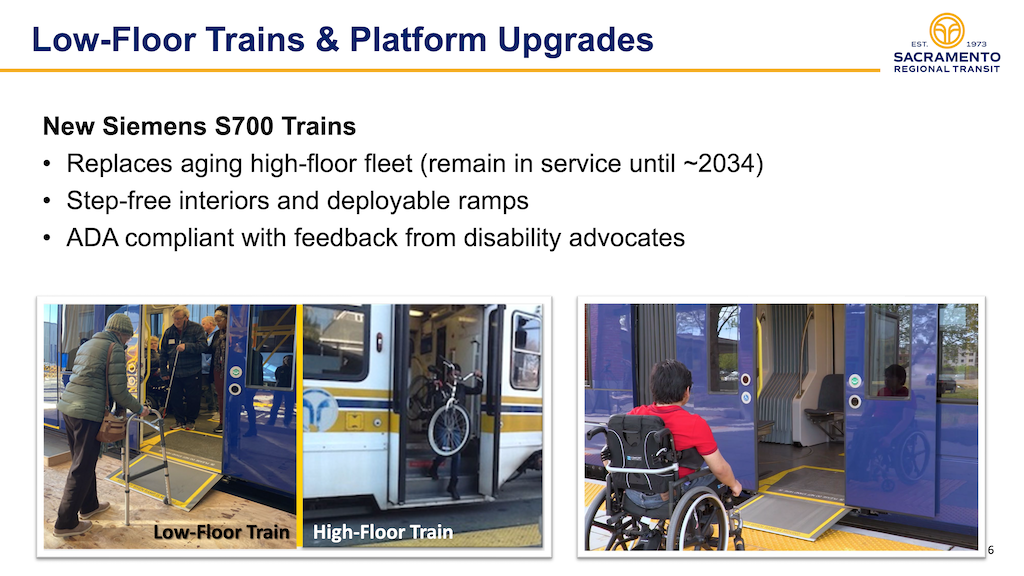
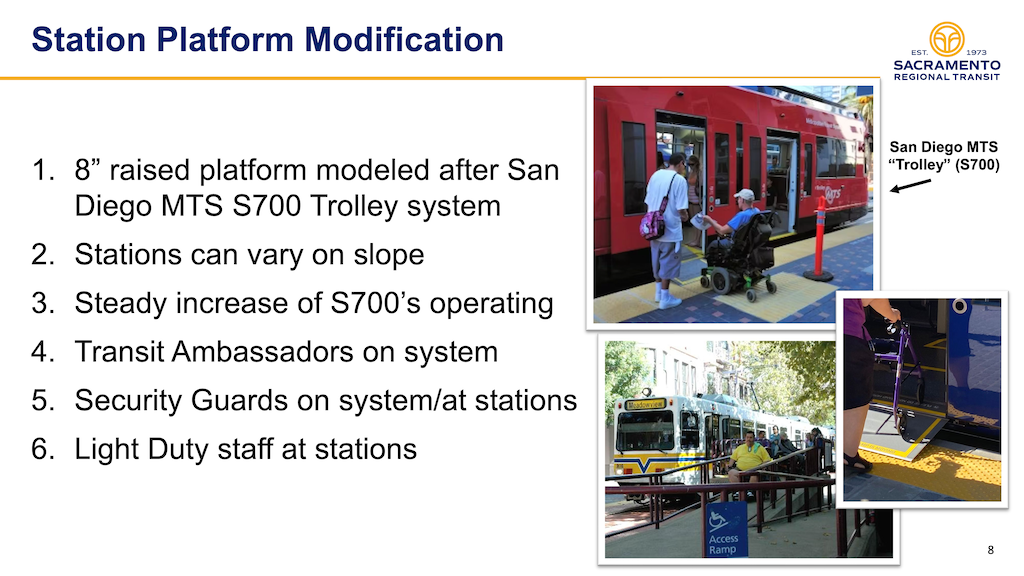
Slide 7 compares the old light rail cars to the new ones, and the old platforms to the new ones. STAR has not heard from any riders that the old cars are preferable to the new ones, but what it has heard, repeatedly, is that implementation of the new cars was flawed.
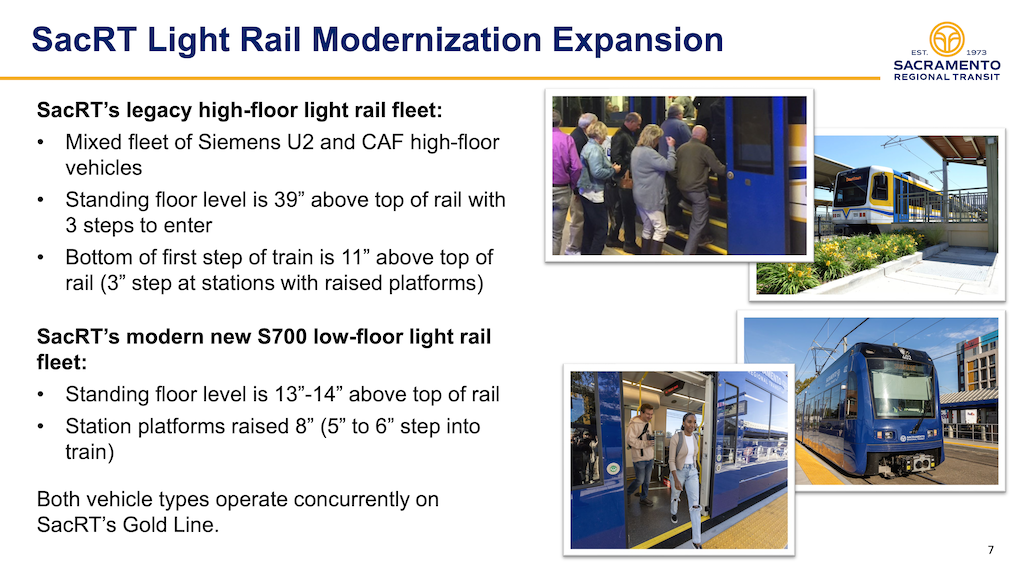
Slide 8 talks about the platform modifications, to create a small step, or ramp, into the cars. It also makes the claim that transit ambassadors, security guards, and light duty staff are assisting disabled passengers. Dan Allison, Action Team Lead, rides light rail Gold Line several times a week. I have never seen any of these assisting disabled passengers. They all are aware of the problems, but have been told by their supervisors that it is not their role to assist. This has been reported by a number of them, directly to me, and commonly, to other passengers, who passed along the restriction. Maybe there has been assistance, but to claim that it is routine is not being truthful.
 Sacramento Transit Advocates and Riders (STAR)