
SacRT provides parking at several light rail stations, charging a dollar per day. Streetsblog is just starting the annual “It’s Parking Madness Time — Send Us Your Parking Disasters!” contest, this year with a focus on excess parking at transit stations. So we looked into the parking capacity at various SacRT light rail stations. We compared boardings (from the SacRT quarterly ridership report), parking spaces, and bus service. Many people arrive at stations via bus routes, and some by walking and bicycling, so boardings does not equate to parking spots. We looked around the see if there are any standards for parking and boardings, but so far haven’t found anything.
The chart below only includes some stations, and only the Blue Line (Gold Line yet to come). Graphed is boardings (blue bar) and parking spaces (green bar) which are on the same scale and are actual numbers. The yellow bar is an estimate of bus service at stations, with 15-minute buses counting 4, 30-minute buses counting 2, and 60-minute buses counting 1, all multiplied by 100 so that it shows up on the same scale. This is an arbitrary number, again without reference to a standard, but it is an important measurement because bus service can largely replace parking, and a station with no or poor bus service will need parking. When bars are zero, there is no parking (no green bar), or no bus service (no yellow bar).
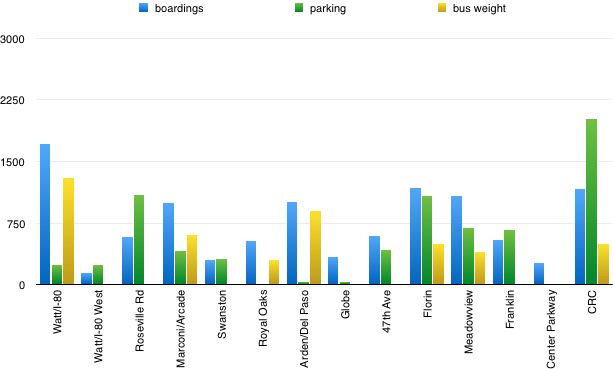
Some stations really stand out. Roseville Rd, the third from end station on the Blue Line northeast section, has 1087 parking spaces but only 581 weekday boardings. This lot is never even close to full, so there is wasted space devoted to parking. However, this is space within the freeway tangle, not useful for very much. SacRT could save some money by removing parking and converting it into bioswales (to absorb runnoff) and/or native vegetation (to absorb air pollution).
CRC, the end point of the Blue Line south section, has 2016 parking spaces and only 1161 boardings, however, both the surface lot and parking garage are shared with the college, so it is not clear whether or not this is excess capacity. I’d need to do more observation to determine this.
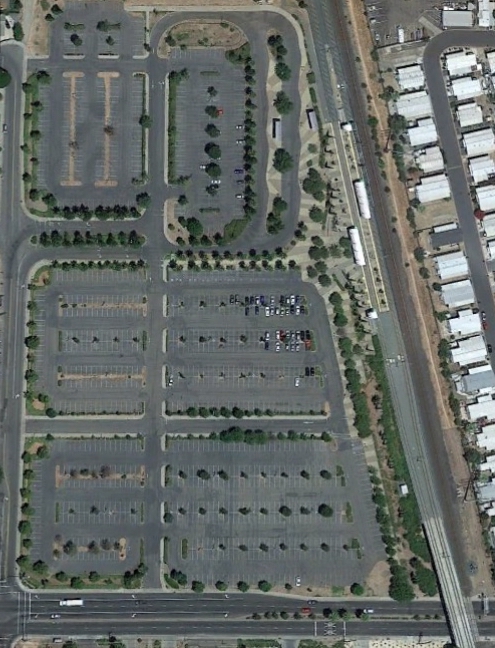
Another station that really stands out is Florin, with 1076 parking spaces and 1181 weekday boardings. Yet it has decent bus service, and I (Dan) have observed many people walking and bicycling to the station. When I occasionally pass Florin on light rail, mid-day weekdays, I am amazed that the lot is almost always nearly empty. One weekday I saw about 20 cars in the lot. The photo below shows the Florin parking lot on Monday, July 11, 2016, a weekday. To save you counting, there are 47 vehicles in the parking lot, and so 1029 empty spaces.
What issues does excess parking engender?
- Parking lots produce runoff that pollutes waterways.
- Parking encourages people to drive to the station rather than using buses, or walking or bicycling. Of course some people live too far from bus routes or on low frequency routes, or in areas with poor walking and bicycling facilities, so there should be a small amount of parking at the stations, at least suburban stations.
- Underpriced parking encourages people to drive. High parking fees might reduce transit use (the jury is still out on this issue and at what price point the impact occurs), but the $1/day fee currently charged by SacRT is too low. If someone is paying $7 for a transit day pass, a parking fee of $3/day or more would not be unreasonable. It is still a good deal compared to $15 and up for daily parking downtown at centrally located garages and lots. The $1/day fee does not even pay for maintenance and patrol of the lots.
- Parking takes up land that could be used for transit oriented development, and if transit oriented development does start to happen, a sea of parking is not a good next-door neighbor, thereby reducing property values. This is an opportunity cost, something of higher value foregone in favor of parking.
- Empty and low-use parking lots are crime magnets, in a way that full or mostly full lots are not. Fewer eyes means more crime.
- The expense of parking building parking lot, a minimum of $10K per space (much higher where the land has a high value or when parking decks (garages) are built. This money could go to better transit service instead. At $10K per space, the Florin lot cost about $10M dollars!
- And, parking requires ongoing maintenance. It costs a minimum of $200, probably closer to $500, to maintain each space each year, so $500K per year. These are estimates, not actual costs from this particular parking lot. A generalized estimate for externalized costs of congestion and air pollution is $100 per month per space, so $1.2M per year. Pretty soon we’re talking real money! [Values generalized from Transportation Cost and Benefit Analysis II – Parking Costs, Victoria Transport Policy Institute (www.vtpi.org)]
Another issue that showed up in looking at parking is that there are a number of light rail stations without ANY bus service. More about that in future posts.
 Sacramento Transit Advocates and Riders (STAR)
Good article Dan.
Ideally, parking would be priced to achieve some high but not full capacity (85 percent is a common number), and that price should be high enough to single-handedly cover all costs of providing the parking (and simply not providing parking is a reasonable option in my book). Florin seems like an ideal location to convert a good chunk of its parking to development, especially since it would likely go unused even if it were free.
I’ll also point out what a lamentable station setup Florin has. Terrible connectivity to the surrounding neighborhood, and it forces buses to deviate from their routes or for pedestrians to schlep across the parking lot. A far superior option would have been to place the station on the overpass over Florin Rd.
LikeLiked by 1 person
We are pleased to have made Streetsblog Cal headlines for the first time! http://cal.streetsblog.org/2017/03/08/todays-headlines-472/
LikeLike
You are right that any deviation for bus routes is not helpful, slowing those routes. Route 54 terminates at the station and is only a low frequency (60-minute) route. Route 81 is particularly important because it is one of the few high frequency (15-minute) routes in the system. A station on the light rail overpass is intriguing, though the one place where SacRT has done this, Watt/I-80, with buses on the Watt Avenue overpass and light rail beneath, does not work very well. However, that may be poor station design as much difficulty with the concept.
LikeLike