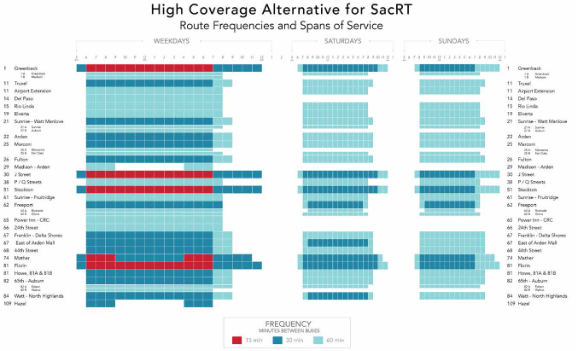
The final post, before our meeting this Saturday, on the SacRT Forward process and documents is on the High Coverage Alternative and High Ridership Alternative route charts. At a glance, the High Ridership Alternative seems to have far less bus routes. However, some of these routes are longer, including some pieces of other existing routes. Don’t look at the charts alone without also consulting the maps. What the charts do make clear is that the High Riderships option really emphasizes frequency, so it could also be called the High Frequency Alternative.
Remember, there is no ‘right’ answer. Ridership (frequency) and coverage are tradeoffs. The public and the SacRT board will need to decide how much resource, in terms of buses and drivers, to allocate to each alternative.
Some transit advocates have suggested that we should maintain the coverage of the existing system, and then apply any new funding to frequency. The problem with this is that all additional funding is speculative. The transportation sales tax Measure B, predicted to be on the ballot in 2020, is uncertain. State funding, a significant part of which is from SB 1, is uncertain. Federal funding is very uncertain, with the current administration refusing to release funds appropriated by Congress. A better option would be to design a network that works with existing funds, and then use new funds allocated to an appropriate mix of ridership and coverage, in order to increase service.
We think it was a mistake for Jarrett Walker Associates and SacRT to use existing route numbers on the maps and in the charts. While it makes sense when a route is the same as or similar to an existing route, there are two pitfalls. One is that routes whose alignment has been changed, or lengthened, or shortened, will not be obvious unless one compares the existing with alternative maps and charts, in detail. Two is that many people look solely at ‘their’ route. If their route is unchanged, or appears at first glance to be unchanged, then everything is OK. If their route has disappeared, however, it is the end of the world. They often don’t look to see if another route, though perhaps further from their origin or destination, might get them there quicker because it is more frequent. Remember, a transit system is about access, can it get you from your origin to your destination within a reasonable length of time. There are an increasing number of options for getting to the bus and from the bus, including micro-transit, ride-hailing, carpool, bike share, bicycling, and of course walking.

 Sacramento Transit Advocates and Riders (STAR)