
A second innovative idea that came up at the Transit Stop Visioning Workshop (Transit Stop Visioning Workshop, October 30; Frequency on bus route signs) is painting bus pads red.
Bus stops are supposed to have red curbs to define the no-parking zone, but some stops do not. Even when the curb is painted red, many people ignore it. People parking in bus stop areas is an ongoing problem along streets with retail business. Some people claim they are stopping ‘just for a moment’, but if that moment happens to be when the bus comes, riders cannot safely board or debark the bus. The bus driver will do the best they can, but it involves safety risks for the passengers, bus driver, and the bus itself. Other people just plain park at bus stops, and don’t care.
Bus stops which are out of the travel lane, which SacRT calls turn-out bus stops, though pull-out is the more commonly used term, already have the handicap that bus drivers must merge back into traffic, which often creates significant delay. Nevertheless, these pull-out bus stops can be improved by painting not just the curb red, but the entire bus pad. A diagram below shows the areas which would be painted red (excerpted from SacRT’s Design Guidelines for Bus and Light Rail Facilities, Figure 7-1. (Since these documents are hard to find on the SacRT website, they available here as well: https://star-transit.org/wp-content/uploads/2021/11/sacrt-bus-light-rail-design-guidelines.pdf; https://star-transit.org/wp-content/uploads/2021/11/sacrt-bus-light-rail-design-figures.pdf.) Where the bus pad is concrete, it is more difficult to paint the surface red and have it last, but it can be done. Less used bus stops with asphalt pads are easier to paint.
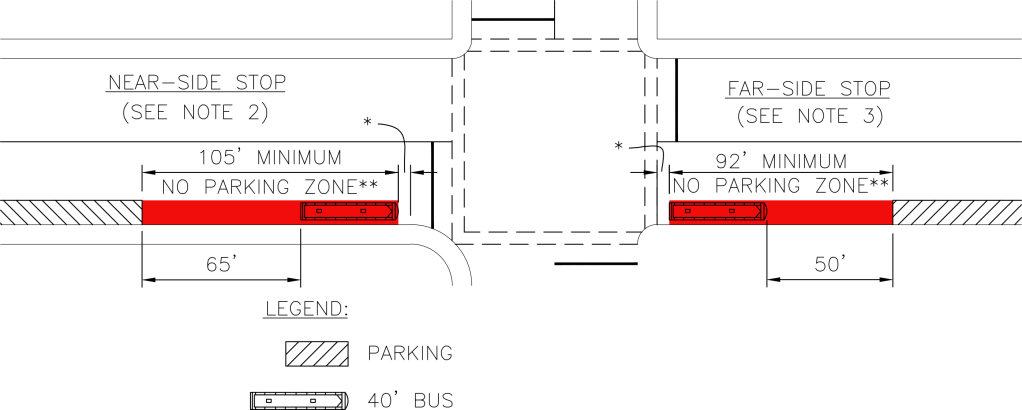
In essence, the red bus pad is a mini-bus lane with appropriate red color. Red bus-only lanes (sometimes with taxi and bicycles permitted) are effective in reducing bus delay. The red bus pad can have some of the same benefit.
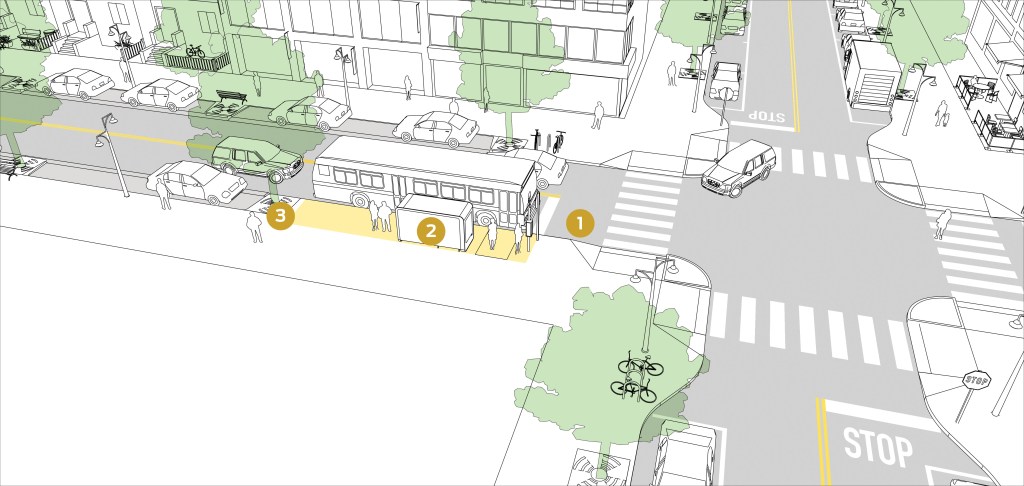
The NACTO Transit Street Design Guide has a similar diagram for far-side pull-pout bus stops.
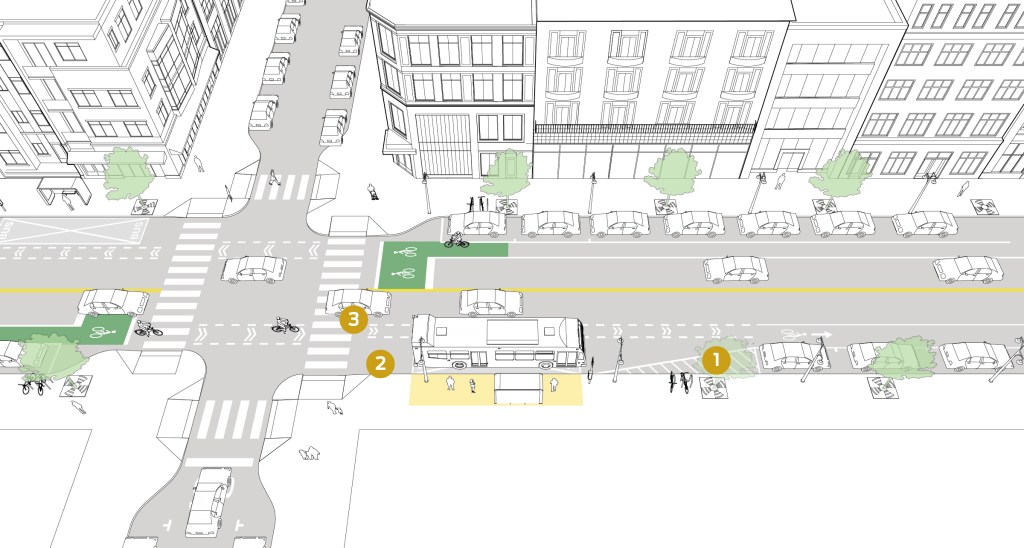
This said, most bus stops should not be pull-outs. Pull-outs give priority to private motor vehicles over transit. The bus should be stopping in the travel lane and not pulling out. Pull-outs may be needed at timed points, specific locations where a bus ahead of schedule waits to get back on schedule. This happens more often on weekends and off-hours. Below is the NACTO Transit Street Design Guide diagram for a near-side, in-lane bus stop. In cases where there is only one travel lane in a direction, near-side stops can reduce private vehicles blocking the intersection, but where more than one lane is available, stops should be far-side.
Of course, there are more complex situations with Class 2 Bike Lanes and Class IV Separated Bikeways, but these two settings of pull-out and in-lane bus stops are the most common.
 Sacramento Transit Advocates and Riders (STAR)