The second virtual public meeting is TODAY, Tuesday, March 8, 2022, 5:30 p.m., https://us02web.zoom.us/j/89978856653.
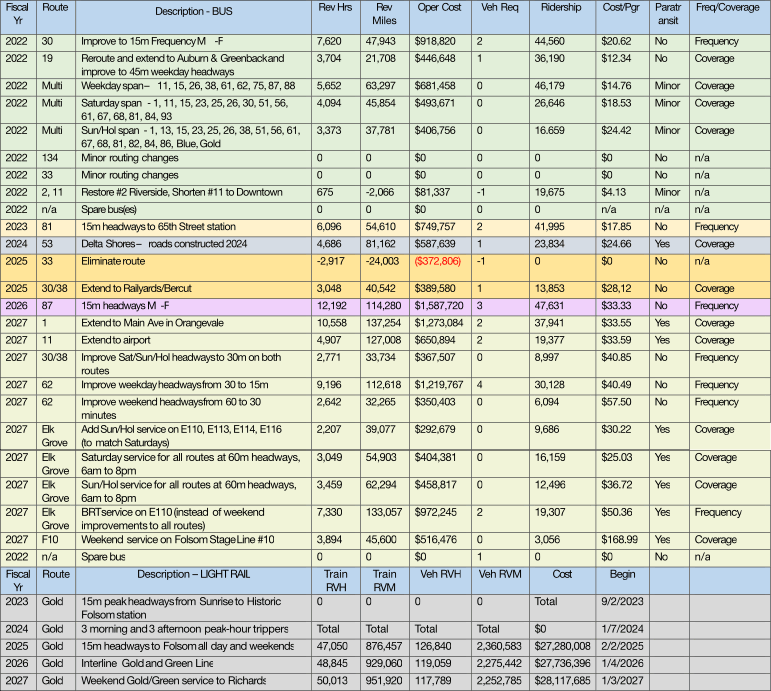
Added: The Five Year Service Plan table, below and pdf.
As is typical of government reports, the SacRT Short Range Transportation Plan (SRTP) includes pages of background information before it gets to the part most people would be interested in. Unless you need a refresher on SacRT, the real plan starts on page 42 and really starts on page 46 with ‘4.7 Future Service’. This information should be up front in document, not buried under background information.
The plan includes 36 pages on the Fiscal Year 2021-2022 Abridged Budget. Not clear why this material in is the plan, unless it is legally required, as it doesn’t add anything to the plan.
Capital Projects
The SRTP continues to prioritize Green Line to the Airport projects. STAR has long objected to the identification of this extension as the top light rail priority, since all possible extensions have never been studied together. We have been unable to find any evidence of either a study or a board decision that the Green Line is the top priority, nor any evidence that extending the Blue Line to American River College and beyond was taken off the table. The SRTP Capital Improvement Plan tables (Appendix I) includes:
| Project | FY 2025 | FY 2026 |
| Green Line MOS 2: Township 9 to Arena Boulevard | $8,500,000 | $28,500,000 |
| Green Line MOS 3: Arena Blvd. to the Airport | $0 | $0 |
| Blue Line Light Rail Extension to Elk Grove | $0 | $0 |
The relevant text in the document is:
5.2.2 Green Line to the Airport
SacRT’s Green Line to the Airport project will extend light rail approximately 13 miles north from downtown Sacramento to the River District, the Natomas communities and the Sacramento International Airport. A map of the locally preferred alternative alignment can be found in Figure 5.1.
SacRT completed a draft Administrative Environmental Impact Report (DEIR) in 2019 and has circulated the information to local jurisdictions for their review and opportunity to provide comments. Next steps include providing the DEIR to the Federal Transit Administration (FTA); however, SacRT will need to have secured funding information to move forward. In the meantime, the project continues to be managed and coordination efforts continue to occur with stakeholders and partners, especially since much of the area surrounding the future alignment is rapidly developing. SacRT considers and coordinates with the County of Sacramento and developers on many potential projects that lie within the area of the future track alignment.
STAR will continue to object to any extension of the light rail system until all possible extensions are studied, and then prioritized based on ridership and other criteria.
The Bus Rapid Transit project is shown with expenditures of about $110M during the SRTP, but the big expenditures are beyond the five years.
STAR has always supported the light rail improvement project to purchase new low-floor, level boarding rail cars and to modify the platforms to fit. We are glad to see significant expenditures on that project.
Under ‘Other Capital Projects’ there are three items that seem to have to do with significant changes to SacRT administration and operations buildings: R Street Operations & Security Control Center, Admin Campus Phase 1, and Renovate Finance Building for Operations. SacRT has been interested off and on in giving up their 1400 29th Street facility and either moving into the suburbs, or consolidating to other locations. STAR is concerned about any such plans, particularly any that make SacRT’s presence in central city less evident, or any move away from the people who most use transit and the central city routes.
Service
The Five Year Service Plan tables (Appendix H) seem reasonable, though of course transit advocates will always support higher frequency routes while maintaining a reasonable level of coverage. The topics include: 4.7.1 City of Elk Grove Annexation and Bus Service, 4.7.2 High Capacity/Bus Rapid Transit (BRT) Service, 4.7.3 Serving New Developments with Transit, 4.7.4 – The Railyards Stadium.
- Year 2022 – Improvements listed in this year include ones that address the largest complaints, and ones addressing the shortcomings with the SacRT Forward project, including things that were planned but did not have funding to implement, or areas where the network ended up too thin. Improvements planned for this year unify span of service across routes, so they complement one another better, increase the length of our service day, and make efficient use of supervisorial resources. Key considerations for changes in this year include the opportune timing for span improvements due to SacRT’s vehicle shortage issue; SacRT can add later hours without increasing the peak vehicle requirement.
- Year 2023 – Improvements listed in this year include the addition of new frequent 15-minute bus service on routes that have been previously considered; however, could not be justified while the core network still had deficiencies. Key considerations include strong ridership and productivity on the selected routes, which are not overly long in running time making the cost to improve more manageable. Additionally, these improvements complement many intersecting routes by providing frequent transfers.
- Years 2024, 2025 & 2026 – Improvements listed in these years primarily include plans to expand light rail service and serve future developments that are planned for the Railyards project area, i.e., Kaiser Hospital, major league soccer stadium, etc.

 Sacramento Transit Advocates and Riders (STAR)
Topics raised during the 2022-03-08 workshop. 1. The document is poorly organized, with the info the public wants, service and capital, buried amongst other information. The service and capital information should be the first two chapters. 2. The plans does not include and there has not been an evaluation of SmaRT Ride microtransit service. When the externally funded pilot project ends in 2023, continuation of the service would compete with fixed route for budget. Microtransit can complement fixed route, but only if carefully planned and implemented. This should be addressed in the plan. 3. Does new development pay for new capital and operations? The answer is complex, but sometimes yes and sometimes no. This should be addressed in the plan.
LikeLike