There have been several proposals to extend Blue Line light rail beyond the Watt/I-80 station, to American River College (ARC), and to further destinations such as Citrus Height, Roseville, or Folsom. This extension of the ‘Northeast Corridor’ was at the top of the list for SacRT years ago, but it seems to have been dropped. Documents on the website disappeared. Staff seems unwilling to discuss this extension, now emphasizing extensions to Elk Grove and the airport. This post is just about the potential extension to ARC, another will talk about going beyond there.
There are really two issues related to getting to ARC. One is whether light rail should go to ARC at all. It currently stops at the Watt/I-80 station, and SacRT bus route 1 takes riders to the college. STAR believes that ARC is a logical and valuable destination for light rail. Sacramento City College and Cosumnes River College (and the Folsom Lake College Rancho Cordova Center) are already served by light rail. The college generates about 31,000 trips per day, and the adjacent streets of Winding Way, College Oak, Orange Grove, and Myrtle are often congested. On the other hand, when college is not in session, the streets around the college are nearly empty. ARC is one of the biggest traffic generators in that area of the county. Light rail to the campus would reduce traffic congestion and provide students travel options that they do not have.
The second issue is the alignment of light rail to the college. One option is to extend from the Watt/I-80 station. Light rail would have to fly over (or under) the eastbound lanes of I-80 and then I-80 Business (the Capital City Freeway). The alignment is not clear, but it would need to reach the intersection of Auburn Blvd and Orange Grove Ave, and then follow Orange Grove to the campus. The alignment would pass through low density residential, probably disruptively.
Another option is to take light rail out of the I-80 freeway median, instead following Auburn Blvd, starting at a point near the Marconi-Arcade light rail station. This also would require a fly over of I-80, but a simpler one.
Some background on the current alignment of light rail is in order. Light rail follows the Union Pacific rail corridor as far as Marconi-Arcade, but then follows a never-built freeway alignment to enter the center median of I-80. Of the three stations along this segment, Roseville Road is used by park-and-ride commuters but is almost completely inaccessible to people walking and bicycling. Watt/I-80 West also has parking, but is almost unused, and is again inaccessible for walking and bicycling. The terminal station, Watt/I-80, has the advantage of offering a vertical transfer between buses on Watt Ave and the light rail station below. But that is the only advantage it has. It is otherwise a miserable station. When the station was studied for improvement or abandonment (Re-Imagine Watt/I-80, Move Watt/I-80?, More Watt/I-80 opportunities), there were no great alternatives, and STAR took a position (STAR position on Watt/I-80) that the line should not terminate at Roseville Road due to its inaccessibility, but was otherwise open to solutions. SacRT decided against Roseville Road, but did not really decide in favor of anything else. The elevators at Watt/I-80 are being replaced but no other improvements are scheduled. As with every rail station in the median of a freeway, the location is very unpleasant. The whine of traffic is constant, and one cannot even hold a conversation there. The design of the station, stairwells and elevators, encourages vandalism and trash, and SacRT has never maintained the station to an acceptable level.
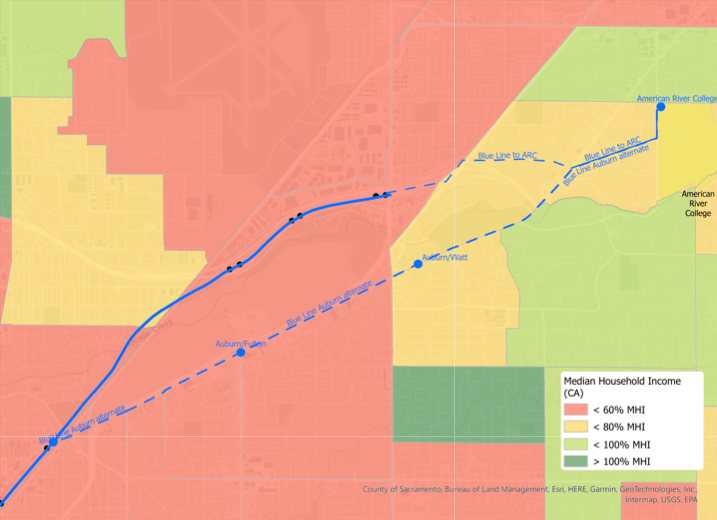
So, that leads to the idea of abandoning the last three stations and re-aligning light rail to Auburn Blvd. The map below shows one possible alignment. From Marconi-Arcade station, it would fly over (or under) I-80 and follow Auburn Blvd, probably street-running. Auburn Blvd is wide and underutilized in this section, and has space for rail. The alignment would then turn east at Orange Grove Ave to the campus. Orange Grove is narrower, but with removal of parking on the north side, there would be space for at least one track. The alignment would terminate on campus, or adjacent to campus, at a location not yet determined.
An advantage to using Auburn Blvd is that it allows for two useful stations, at Fulton and at or near Watt. The demographic maps following give an indication of the benefits of these stations. The original design of the light rail was to bring commuters from the far suburbs into the central city, with little attention paid to the people or destinations along the way. A change to following Auburn Blvd would again serve people and businesses, as well as education destinations. This is a more urban model of light rail, and in the view of most experts and researchers on rail transit, a much more productive model.
Of course there are many, many questions about all of these ideas. Look at the map below. The new alignment on Auburn engages with bus routes 26, 84, and 1. pdf

The population density map below shows that there is some density south of Auburn, and almost none north. The density is single family residences and low density commercial along Auburn, but at least there are people to be served, unlike the existing alignment. pdf

The median household income (MHI) map indicates no significant difference between the two alignment options.
The low income high minority (LIHM) indicates low income areas for both alignment options, but the existing alignment is not accessible to those areas to the north. The new alignment would be accessible to those areas to the south. pdf

 Sacramento Transit Advocates and Riders (STAR)
I’d like to correct your information on the Reimagine Watt/I-80 Master Plan. The SacRT Board approved staff’s recommendation to keep the transit center open (the system’s highest ridership transit center) and modernize it to make it safer, cleaner and more accessible. Since then, SacRT has received 2 grants towards that goal and are finalizing designs, while upgrading the elevators as the first phase. https://www.sacrt.com/apps/sacrt-receives-funding-to-modernize-transit-system/ SacRT is also working with regional partners to improve access to the transit center.
LikeLike
It’s depressing how little imagination SacRT has when it comes to system expansion. It seems that they have no real sense of direction for what they want to do.
LikeLike